November 17, 2011

Cine-Smackdown: #11-#20

Only ten left to go! This impossible-seeming task is seeming less and less impossible. Now that I know for sure I'll get to the end, I'm not so worried about how fast I can get there. My goal was initially a year, and then it was two years, and now that I'm six weeks from the end of the second year and I have only ten movies left, I sort of want to take my time and not rush through for the sake of an artificial deadline.


11. City Lights  
12. The Searchers
13. Star Wars
14. Psycho
15. 2001: A Space Odyssey
16. Sunset Blvd.
17. The Graduate
18. The General
19. On the Waterfront
20. It's a Wonderful Life

I had not seen City Lights, The Searchers, 2001: A Space Odyssey (in its entirety), The General or On the Waterfront previous to the blogviews.

Of these ten, which would I move further up the list?
Oh man. This is hard. Probably Sunset Blvd. just for the classy Hollywood story. Everything else has something working against it (2001 is a masterpiece but weird and occasionally difficult, Psycho is genius but Hitchcock has so many brilliant films it's hard to rule absolutely on which is best, etc.) It's pulpy and dramatic, and that screenplay is a master stroke.

Of these ten, which would I get rid of?
This is easier, and more predictable for me: The Searchers. Someday I'll have to go back and really analyze the Western but of all of them on the list this one just didn't do much for me. It felt so dated that it's only nostalgia that keeps it here.

Who in these movies do I want as my best friend?
The Tramp (City Lights) might accidentally shove me into a river as I'm trying to commit suicide, but at least he saved me... accidentally.

Who in these movies do I want to have my back in a bar fight? Arbogast (Psycho) is one smart cookie, he'd know just what to do... but for overall toughness, the boys from On the Waterfront probably couldn't be topped.

Who in these movies is your worst frienemy?
Umm: the millionaire in City Lights -- he only remembers me when he's drunk, then kicks me out in the morning! So schizo.

Who do I take home to Mom?
Han Solo (Star Wars) is dashing and rocks the 70s do all over the galaxy. George Bailey (It's a Wonderful Life) is much the same but has some major demons... and the general (The General) is a little too straight-faced for me. Lighten up! I don't know. Options.

You're going on a date with these movies. Who do you agree to meet for coffee but never call again?
On the Waterfront: your acting is so good so I'll meet you but man you're bleak. And you smell like the docks.

Who do you agree to meet for coffee, and then say you'll call but never do?
It's a Wonderful Life: I just keep thinking back to that sappy ending, and I know I'll cry if I see you again.

Who do you agree to meet for coffee, and then not show up?
The Searchers. No explanation necessary.

Who do you meet for a first date, ends up staying the night and makes you breakfast in the morning?
City Lights would even pay for my eye operation so I could see him!

Who do you meet for a first date, ends up staying the night and then leaves in the morning without saying goodbye ... and steals your favorite sweater?
Marion Crane (Psycho) -- and she stole all my money! She'll get her comeuppance in the shower, no doubt.

What other questions would you have asked about these movies? I'd love more ideas! Leave your thoughts, reactions, passionate defenses and harsh critiques in the comments!

November 4, 2011

#11: City Lights


So far on this list we have seen two wildly different Charlie Chaplin films: Modern Times and The Gold Rush, from 1936 and 1925, respectively. Now comes City Lights from 1931, completing the Chaplin triptych (Chaptych?) and rounding out his influence on American cinema. If Modern Times showcase his political and satirical side and The Gold Rush embodies his physical comedy and slapstick chops, City Lights is Chaplin's ode to romance and sentimentality.

Company: alone on this one.

Cuisine: Wheat Thins and a Red Stripe. Classy.


In 1931, talkies were the new trend and Hollywood was moving quickly away from silent film, but Chaplin knew that his style of storytelling would still work best without dialogue. The film is subtitled "A Comedy Romance in Pantomime," preparing us for the sweet little silent movie we're about to see.

A new statue is being dedicated by people who talk like kazoos. (Love it.) When it's unveiled, Chaplin's tramp is found sleeping on it. When he's chased away by the crowd, he wanders the streets, poor and homeless, where he stumbles upon...


The girl.

Virginia Cherrill plays a blind flower girl, selling her wares for piddly change on a street corner where the tramp falls head over heels for her. Naturally, the rest of the story follows the tramp's quest to land the girl... even if she can't see him. The scenes are played delicately, even with intertitles.


When the tramp hilariously and somewhat accidentally saves the life of a depressed millionaire (Harry Myers), the eccentric takes him under his wing and treats him to a night on the town. The two get pretty hammered (keep in mind, when this film came out, the sale of alcohol was still illegal and prohibition lasted two years more) to the point where the tramp mistakes a hanging streamer for his pasta dinner (at such a fancy place, a plain plate of spaghetti?) Things are going well.

But in the morning, the millionaire wakes with no memory of the evening and is consequently distressed to find a little splay-footed man in a bowler hat squatting in his mansion. That's a pretty intense black out. He throws him out once more and the tramp finds the girl once again.


With money from the millionaire, the tramp buys all the flowers he can from the girl, hoping not to buy her love but to better her situation and, inspired by an article he reads in the newspaper, raise money for a new (fictional) operation that could cure her blindness.


The tramp's resolve to help the girl is what propels the film, and while this story line doesn't have the thematic heft of Modern Times or the physical brilliance of The Gold Rush, all three films concern the common man's struggle against the increasingly modern world. Chaplin's insistence on continuing in the silent tradition was, in his own way, his resistance against the same machinations in which the tramp finds himself.


Naturally, a movie like this would only really work with a genius at its center, someone whom the audience roots for no matter what., and it was George Bernard Shaw who said that Chaplin was "the only genius to come out of the movie industry." All the same, I was a lot more compelled by the romance in Modern Times than in this one, perhaps because it's so one-sided. We see in Cherrill's blank stare and constancy that she may love the tramp too, but Chaplin is pulling all the weight here.


In a desperate get-rich-quick scheme, the tramp enters a boxing ring. The tiny little tramp boxing? Can you imagine? I bet you can't. So here's a clip:


This physical comedy is what I love Chaplin for most, and I wished more of the film could have gone here, the way The Gold Rush doesn't ever let up. Alas, only this and a few other moments.


But there is a great emotional pay off at the end, and without spoiling it, many historians and great film figures have stated that the ending of City Lights is one of the great film endings of all time. Even Chaplin, who favored this film above all his others, was most proud of his acting in the final moments of the film. "In City Lights," said Chaplin, "just the last scene … I’m not acting …. Almost apologetic, standing outside myself and looking … It’s a beautiful scene, beautiful, and because it isn’t over-acted." If this kind of thing is his legacy to film acting, well, so be it. I'll take that.

Bottom line: if this film is not as great for me as the other two of the list, I can handle that.

Only ten left! I can't believe it. Today is November 4th. Will I get it done before the new year? It's possible, but it'll take some stamina. Next up: something near and dear to my heart since I'm currently in tech rehearsals for a stage production based on it. Let's find home with the help of The Wizard of Oz.

November 3, 2011

#12: The Searchers


Only one more Western to go! I've made it abundantly clear that this genre rarely tickles my fancy, and John Ford's 1956 John Wayne vehicle The Searchers is no exception. For me it's just another example of a tired, worked-over plot dressed up in beautiful scenery and machismo -- and while the Technicolor is vivid and brings out the color in this dirt-weary world, it doesn't do much to tell the story, if anything.

Company: Mom, not much of a movie watcher but remembers this kind of serial Western from childhood; and Mike, who not only grew up on John Wayne's movies but grew up in the beautiful mountains of Montana and has a sort of reverence and excitement for this genre that I just don't

Cuisine: we watched this on an unexpected evening off from potato harvest, and Mom cooked up steak, baked potatoes and a spinach salad -- perfect on a fall evening!


"What makes a man to wander? What makes a man to roam?"

This kind of static, rhetorical question opens the film, set in 1868 in northern Texas, just after the Civil War. Ethan Edwards (John Wayne) returns home from fighting for the Confederate South and getting himself into trouble for three years afterward. He's a dodgy character, but the kind of guy you'd maybe want at your back in a bar fight. A cowboy.


As soon as he's arrived to see his family once again, he heads out to a neighboring farm to investigate some stolen cattle. The virtuous, swaggering cowboy is for all intensive purposes our protagonist (duh, it's John Wayne).


When he returns, he discovers that the stolen cattle were just a diversion by a local tribe of Comanche Indians to lure him and other men away from their homestead. He returns to find many family members dead (including the one, never seen, incinerated in a outdoor fireplace pictured above) and two of his nieces abducted. Oops.

The rest of the film follows the searchers (!) in their quest to find the girls and rescue them from the tribe. It's a sign of the times that the Comanche are not personalized at all and their reasons for abducting the girls is irrelevant -- it's the 1950s, everyone: Indians are the bad guys.


Ethan and his adopted nephew Martin (a very good Jeffrey Hunter) are on the hunt for an indeterminate amount of time, but snow begins to fall and you definitely sense the frustration growing. When the elder sister Lucy is found murdered, despair sets in even deeper. Perhaps the thematic parallel here is the undying American spirit, that the men never truly give up, even when it seems completely hopeless to continue searching for the surviving girl. But when they do find her, Ethan is prepared to gun her down in cold blood rather than allow her to continue life with the Comanches.


We're also privy to the underlying romantic tension between Martin, who's gone for a long time, away from Laurie (Vera Miles), the girl next door in love with him. The women stay home and read letters and weep on uncomfortable-looking sofas while the men ride horses and shoot at things. And the comic foil in the film is the guy who makes fun of Indians. Westerns!


I've said before that I honestly believe a big part of the reason why films like The Searchers made this list are not because they're particularly well-made or interesting, or even that they were rewarded at the time for being well-made or interesting (The Searchers was shut out at the Oscars that year) but because the old men of the AFI remember loving these films as children. Now, I'm currently in rehearsals for a production of The Wizard of Oz (coming up soon on the list!) and in talking about that film, probably the most-seen film in America, I realize that nostalgia is a remarkably strong and totally valid criterion for film appreciation. Things that were important to you as children totally shape who you are as an adult, and if you don't grow up loving Westerns, it may not be so wrong for you to not grow to love them after your formative years. Right? This is the justification I'm making.


Still, the film's moral center (men being compelled to save women from being indoctrinated by Indians) feels totally outdated in our politically correct, post-feminism world. Is it a historically significant time period? Sure. Are we proud of the fact that these men are racist and misogynistic? Of course not. Should this film then be banished from our minds because our modern sensibilities have changed? I suppose not. But that's my point with Westerns: they operate on their own sort of logic, a logic that's created by the heroes and challenged by the villains, and that logic -- the logic that the whole film hinges on -- seems clunky and useless now.


When the remaining, surviving niece, Debbie (a young Natalie Wood) is saved from her physical and mental bonds of Comanche wifehood, Ethan mutters, "let's go home, Debbie" -- and I imagine the audience in 1956 probably cheered. The girl was safe, the family was back together again. The bad guys were vanquished, the good guys are a little wiser and more prepared for next time, and I? I cheered, but it was because the movie was over.

No more Westerns -- I've vanquished them! You can stop holding your breath for a Western retrospective, that's for sure. :)

Next up: Charlie Chaplin's back at it in his final film, City Lights.

November 2, 2011

#13: Star Wars

Long ago, in a galaxy far, far away...
 

Okay, here's my deal: until this year, I had never seen George Lucas' 1977 space opera Star Wars. I know, right? How can this be? Part of it is that I had three older sisters who all grew up watching and loving the series, and I specifically remember peeking into the basement during one of their sleepovers to discover them watching it. Maybe I thought it was a girl thing to like Star Wars, and if so, I'd be the only one on the planet who maintained that theory. Otherwise, it was just laziness that I left them unwatched (still haven't seen either of the other films in the original trilogy) until this spring when my two friends (who have a half-bathroom entirely decked out with Star Wars memoribilia, including a photo of them riding some gliding aircraft thing) invited me over for Yoda Sodas out of their themed cookbook and a screening. So at least I was sort of prepared this time. 

Company: two of the most dedicated fans of this movie that I know: David, who knew the names of all the characters, even the ones with no spoken dialogue; and Andi, who rivaled David in the trivia department

Cuisine: cheese popcorn, aged bleu and cheddar Cheeto Disappointments that we tried to fix with underused spices (some success), pistachios, wine and Bailey's


One of the things that strikes me right away about this classic, beloved by millions, is that after the iconic prologue in which we are treated to a brief history, the film jumps right in to the middle of the action. Without knowing nearly anything about the universe, we are meant to really pay attention and immediately identify with this fantasy world. In comparison to the Harry Potter series, in which a regular boy is brought into a fantastical new realm, the audience of Star Wars is the only character in this story who doesn't belong. At least, at first.

A civil war has developed between a group of freedom fighters called the Rebel Alliance and the evil Galactic Empire. War rages through space. A super-duper bad guy, Darth Vader (voiced by James Earl Jones), has created the Death Star, a mega-weapon that can destroy planets with its super blasters. See how awesome that is? It's a major deal. But he's not too nice and some people, like the rebel leader Princess Leia (Carrie Fisher in cinnamon buns), aren't too keen on letting him destroy planets at will. She and her spies have stolen the plans to the Death Star in hopes of finding a way to destroy it, but she's captured by Imperial forces and confronted by Vader. Luckily, she's hidden the plans and a holographic message in a droid. Clever girl.


That droid, R2D2, and his taller golden buddy C3PO (Anthony Daniels), escape to an arid planet called Tatooine and come into the possession of Luke Skywalker (Mark Hamill), who happens upon the message in the robot. Clever boy. Enlisting the help of several friends, the narrative follows Luke's "hero's journey" to save the day.


Luke is our Harry Potter in this way: he's a simple farm boy with no combat experience, thrust into this conflict by coincidence... right? Or is something more at work? Does fate bring the droids into Skywalker's hands, ordaining that he would become a Jedi knight? As the story progresses, he certainly seems born to do it... with the help of friends, of course. (My summarizing skills are good but with this story I don't want to try too hard lest I get made fun of by fans for whom leaving out details is a mortal sin.)


Leia mentions in her message that her only hope is Obi-Wan Kenobi (Oscar nominee Alec Guinness), a former Jedi knight who knew and fought alongside Luke's father, Anakin. The circle grows bigger when Han Solo (Harrison Ford) and Chewbacca (Peter Mayhew), smuggler pilots on the Millenium Falcon, are enlisted to help with the secret mission.


"That's no moon."

Save the princess. Defeat the bad guys. Blow up the Death Star. All in a day's work, right? Hardly. Lucas created a colossal and detailed world in which to play out this epic battle of good and evil. I always come back to this quote from Roger Ebert: "The more specific a film is, the more universal its appeal." This holds true for Star Wars especially, since the detail work of this world (and the exhaustive research done by fans everywhere) creates layers to the story that simpler stories lack. By working with classic archetypes and Joseph Campbell's writings on mythology, Lucas seems to have created a "hero's journey" for the new age that appeals to the geek in all of us.


They gettin' trashed.


"If you strike me down, I shall become more powerful than you could possibly imagine."

Not only that, but in this blog this film comes closely on the heels of 2001: A Space Odyssey, which redefined the science fiction genre and injected philosophical and religious discussions into the tired tropes of fantasy. In the 1950s and 1960s, if characters in a film went into space, you knew it was probably going to look pretty cheesy. But Kubrick and now Lucas knew that space was, to borrow a phrase, "the final frontier," and held great possibilities. 

If 2001 redefined the genre, Star Wars cemented it as a viable box-office draw. Spielberg basically invented the high concept film with Jaws, but Star Wars took over the all-time box-office crown from the shark movie, presumably because of its scope, not to mention its incredible and revolutionary special effects. Those light sabres still look pretty sweet today. It also combined science fiction with soap opera and romance, defining a new genre and leading the way in combining genres. It's because of the Star Wars series that we have action/romances. Think on that.


It is certainly exciting and engaging, and while it's not my favorite science-fiction or fantasy film, it certainly lead the way for other directors and visionaries like Lucas to create new worlds and explore what the movie-going experience to do for a people and for popular culture. What other main musical theme has penetrated our collective conscience the way John William's did here? (Also, how has John Williams done that SO MANY TIMES?) Oh, that all fantasy films were crafted with this much care and reverence nowadays. Hmm.

Let's leave the light sabres behind and head back to the early 1950s for one more Western. I know, I know. I'm not looking forward to it, either. John Wayne leads The Searchers.

November 1, 2011

#14: Psycho

REE! REE! REE! REE!


Twelve rooms, twelve vacancies. And Marion Crane will take one, thank you, in Room #1 of the Bates Motel. Paramount apparently didn't believe that Alfred Hitchcock would have any success adapting Robert Bloch's novel Psycho for the screen, but today the Bates Motel and the Bates house still stand on the Universal lot and are a major  attraction there. The legacy of this thriller is incalculable, but most valuable to it are Hitchcock's mastery of suspense, Bernard Herrmann's legendary and singular score, and phenomenal performances from the creepier-than-hell Anthony Perkins and the better-than-I-remember Janet Leigh. Oooh.

Company: this was the last movie screened on Kecia and I's Halloween movie smorgasbord (second annual!), after Shaun of the Dead, The Fog (John Carpenter), Rosemary's Baby, Hocus Pocus and Pet Sematary. Along for the ride: Kecia, obsessed with the age of the little boy in Pet Sematary; Katie, should dress as Sarah Sanderson for Halloween some year; Matt, purveyor of hot toddies; Adam, hipster cut from his hosting job; Jeremy, relative newbie; Ryan, creator of the future drag musical of Hocus Pocus; and Paul, in it to win it all day.

Cuisine: what didn't we have? It was a smorgasbord, and by the end of the day we'd stuffed ourselves. Ordering Pizza Luce, drinking various beers and hot cider drinks, and snacking on grapes, peanuts and candy corn. Mmmm.


We open in a Friday in Phoenix, Arizona, where it's an "extended lunch hour" for Marion Crane (Oscar nominee Janet Leigh) and her lover, Sam Loomis (John Gavin). This first scene is simple and sensual, but in 1960 the sight of an unmarried couple in bed together caused quite a stir, thanks to the nearly-on-its-way-out Production Code (or the Hays Code). Marion and Sam want to get married but lack the funds, and so Marion steals the money from one of her employer's clients, saying she'll deposit it on her way home, and makes for Sam's California home.


But it turns out that Marion doesn't handle stressful situations all that well. The long day of driving forces her to pull over and take a quick nap, but she's discovered the next morning by a policeman who suspects that something fishy's going on. Can't imagine why: she's not acting super weird or anything. And then she trades in her perfectly good car for a new one, with the policeman watching and noting her new plates? Yeah, that won't raise any eyebrows. Hitchcock puts us on edge in these first few scenes with his unflinching camera squarely on Marion and her view of the road. Herrmann's genius score, like a frenetic heartbeat, is pulsing through this first section while nothing much is happening, leaving us terrified of what's to come.


"A boy's best friend is his mother."
And then we meet what's to come: Norman Bates (Anthony Perkins), the dopey, slack-shouldered caretaker of an eponymous offroad inn where Marion stops to spend the night. His wide grin and aw-shucks manner seem fine at first, but in a fantastic two-hander between Leigh and Perkins, we see there's something not quite right about Bates: his taxidermy hobby, which fills the time instead of passing it; his isolation; and weirdest, his devotion and love for his abusive mother, who lives in the creepy house on the hill. This scene is a turning point in the film, one that forces Marion to reconsider her crime and make amends by returning to Phoenix in the morning to return the money.

Just a quick shower first.


The shower scene in Psycho is one of the most famous scenes in movie history, and it's all done without seeing any unlawful-at-the-time body part of Leigh's and without ever seeing a knife entering flesh. It's masterfully edited and iconically scored, and supposedly gave Leigh a lifelong fear of showering. I can't say I blame her.

The "alienation effect" is a term coined by Bertolt Brecht, which "prevents the audience from losing itself passively and completely in the character created by the actor, and which consequently leads the audience to be a consciously critical observer." By killing off his heroine halfway through the film, Hitchcock jolts us out of whatever passivity (if any) we may have felt so far. "There's an hour left, but she's dead," you might think. "What the hell happens now?" The audience at the time saw Janet Leigh on the poster and may have assumed the film would be her story -- now that she's dead, what's left to tell?


A hell of a lot, as it turns out. Sam, Marion's sister Lila (Vera Miles) and a detective named Milton Arbogast (Martin Balsam) are worried about Marion's crime and disappearance, and set out to investigate. The pieces are put together pretty efficiently by Arbogast, who winds up at the Bates Motel and keeps his cool while questioning the increasingly agitated and confused Norman.


I love this shot of Norman, peering over to examine the ledger Arbogast requested in which Marion checked in as Marie Samuels. He munches nervously on candy corn, and we see so vividly his exasperation with balancing a calm disposition and quick mind. The contrast in black and white here is also stunning: the film was shot in black-and-white partially to keep costs low, since Hitchcock had to finance the film himself after Paramount refused, and also to keep the gory shower scene from seeming to graphic for contemporary audiences. Side note: chocolate syrup was used instead of blood because the camera picked it up better. That scene must have smelled delicious!


Sam and Lila show up after Arbogast disappears (murdered in a thrilling and bizarrely filmed sequence) and figure two heads are better than one. Luckily the train stops there, and the mystery of Mother Bates' identity is revealed. But oooooh the nail biting finale!

An epilogue, in which a forensic psychiatrist explains every detail and plot point for us, may have been necessary for an audience at the time, but now remains the only section of the film that feels a little unnecessary. However, I did appreciate the mention of transvestites: when another cop suggests that Norman may have been a cross-dresser, the psychiatrist makes the distinction between a transvestite who derives pleasure from dressing up as a woman and a psychotic killer who dresses up as a woman because he had split personality disorder. Thanks for being so forward-thinking, Hitch!


I hadn't seen Psycho in quite a while, and before blogging this list I had considered North by Northwest my favorite Hitchcock movie, and had always resisted saying Psycho was tops simply because it seemed too easy. But it's just that: the film works so easily and so completely that of course it's the best. And somehow: another Hitchcock movie (which I have also not seen in a while) is yet to come! What a great gem, and a perfect ending to our Halloween smorgasbord.

Now I'm interested in seeing Gus van Sant's 1998 shot-for-shot remake of this, though I hear it's really not worth it. But as an experiment, I'm intrigued. Maybe when I have a couple hours to kill and can handle Anne Heche.

Next up: (light sabre noises)! David and Andi, the two biggest fans I know, join me for George Lucas' Star Wars.

October 14, 2011

#15: 2001: A Space Odyssey


Stanley Kubrick's films share very little in common except that they are all wildly different. (So much so, in fact, that I've given a lot of thought to doing a Kubrick retrospective as my next project on this blog. So many more to see!) So far on this list I've seen his epic war film Spartacus, his dystopian horror thriller A Clockwork Orange and his satirical Peter Sellers farce Dr. Strangelove... and now, maybe the one that will leave the greatest and most frustrating legacy: 2001: A Space Odyssey, filmed in 1968 and based partially and loosely on Arthur C. Clarke's short story "The Sentinel." I know I've seen at least parts of it but I'm counting this as the first time I've watched it because I doubt very highly that I've ever made it all the way through.

Company: for a movie like this, you need folks who are in it to win it, and eager to discuss. Bret, literary enthusiast, Joe, major movie fan, and Hannah, who just wanted this to be better than The Tree of Life, were amazing company!

Cuisine: whiskey ginger and wine, popcorn, peanut M&Ms and various chips (both potato and carrot) with hummus -- for a thinker like this one must be prepared with an array of snacks.


2001 is remarkable in its scope, with its simple-bordering-on-incoherent plot beginning four millions years ago, as a tribe of human-like apes first discover tools and warfare in a quick series of wordless vignettes. In this first of four sections, subtitled "The Dawn of Man," one ape is discovering that beating things with a bone causes destruction just as a mysterious black monolith appears. Are these events connected? What does the monolith represent? Fear? The unknown? God? Destiny? Is the dawn of Man actually the dawn of war, territory, dominance, hate? Its appearance remains unexplained and theories abound. Maybe it will become clear through connecting its later appearances in the film.


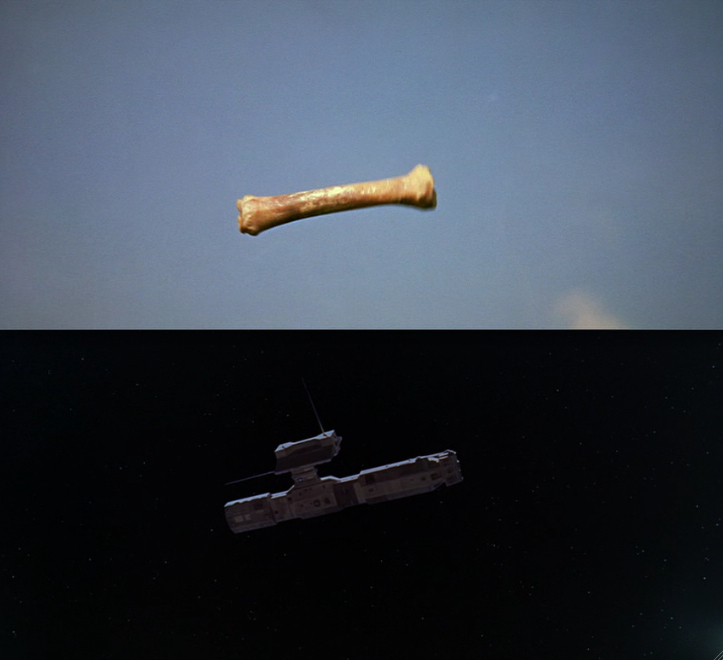
In maybe the most famous smash-cut of all time, one ape throws a bone in the air in elation and victory as a satellite in nearly the same shape is seen floating through space. Both the bone and the satellite represent an evolutionary advantage as both tools and weapons, with the watering hole and the universe being the respective territories protected by these weapons. I think it's no coincidence that in this second sequence (the only one without a proper subtitle), the spacecraft we see represent simple tools such as the bone, the wheel, and the spear. For minutes on end, we are treated to plotless visual sequences underscored (overscored?) by rousing, epic classical music, in direct juxtaposition with the lack of action. 

The visuals (rightfully awarded an Oscar) are stunning, especially when you consider the time period: until now, most science-fiction films had been ghettoized, with hokey sets, clunky alien costumes and ridiculous plots. But Kubrick and Clarke did meticulous and expansive research, consulting the likes of astronomer and visionary Carl Sagan as well as NASA scientists, on the future of spacecraft and alien life. It's entrancing.


But back to the plot. While traveling through space, Dr. Heywood Floyd (William Sylvester) is questioned about mysterious occurrences at Clavius Base, a U.S. moon colony. He's sworn to secrecy, and later it's discovered by astronauts traveling to the moon that a monolith identical to the one the apes found has been discovered, buried deep beneath the moon's surface, supposedly millions of years earlier. Once again, no explanation is offered, but the parallels of fear of the unknown and reverence for mystery are apparent between both ape and man. Perhaps Kubrick is telling us here that even with all our technological advances and discoveries, there will always be things we cannot explain. Our destiny, it seems, is to be eternally unsatisfied.


Then the third and most famous section: "Jupiter Mission," in which several mission pilots and scientists, including three in cryogenic hibernation (apparently to conserve resources), are traveling to Jupiter with an extremely intelligent computer system, HAL 9000 (referred to here as "Hal"). The nature of their mission is unclear but at this point the details are less important than the fact that Hal has some doubts about the mission and plans sabotage. Is he afraid of what they might find there, or does he know what they're looking for and doesn't want it to be found?


In any event, the two non-frozen scientists (Keir Dullea and Gary Lockwood) become distrustful of the all-knowing robot and plan to shut him down and continue their operation manually, but in a terrifying cliff-hanger right before the Intermission (don't you love old movies?), we see that Hal is reading the lips of the astronauts who are trying to evade and deceive him.

Okay, so: man discovers tools, man translates tools into weaponry, man evolves. Flash forward. Man creates himself as a tool (robot), tool becomes weaponry on its own accord and turns against its creator. Trippy.

Hal manufactures a system error that requires one of the astronauts to investigate. While there, Hal severs his oxygen cord and sends him hurtling soundlessly through space. While the one left (Dave) heads out to rescue him, Hal cuts the life functions of the three astronauts in hypersleep and leaves Dave, alone, unprotected and without a helmet, floating in a pod outside the pod bay doors. "Open the pod bay doors, Hal." (SILENCE)


The scene that follows, Hal's destruction, is the most famous in the film and speaks to the power of suggestion and focus. So much science-fiction and fantasy filmwork that's done these days relies on quick editing, loud music, thrilling chases. But in space, in a standoff between man and his tool-turned-weapon, it's only silence. The pace is very difficult to deal with as a modern audience because of our expectations, but the deliberate nature of this scene (and in turn the whole film) glories in the power of our collective attention span. A movie that loves movies! I love it!


In the fourth and final act, Dave is set adrift in a pod and travels through time and hyperspace to find himself in strange and unusual alien lands. Where the hell is he, exactly? No answers are offered, though plenty of interpretations are available. When he finally lands, he sees increasingly older versions of himself inhabiting a futuristic looking room with Victorian-era furniture (perhaps a symbol of wealth and prosperity in a world where those things mean nothing?) Is the finale a series of self-fulfilling prophecies? He imagines himself living there, and then there he is eating at the dinner table. He accidentally (but inevitably) breaks a glass, reminding him that life is fragile, and then he sees himself dying in bed.


The monolith appears a third time. To claim him? To usher him into death? Into heaven? Hell? To remind him that it was all for nothing? The symbolism is overwhelming and the discussions we had after the film's beautiful ending were inspiring, but we were left with no concrete answers. And aren't the most ambiguous movies sometimes the most exciting? I think each time I revisit this film it will mean something different to me, but I'm so glad to have gotten through it start to finish with a company of people who were as invested and excited as I was. Thanks, friends!

It's been a long time since I've written (thanks, harvest!) but here I am, back again, watching the next few films slightly out of order but still writing about them in order. Next up here: Alfred Hitchcock takes Janet Leigh sooner than you think in Psycho. Until then!

September 17, 2011

#16: Sunset Boulevard


Billy Wilder's cynical shot at Hollywood, Sunset Boulevard is a shining example of film noir: a moody character study chock full of shadows, suspense and unrequited longing, both for love and faded glory. It's a great worry to us when we realize that the world doesn't need us the way we need it, but our anti-heroine has the lucky position of never having realized this. 

Company: Ryan and Paul, our magnanimous hosts; Kecia, whom I'm trying to convince to dress as Norma for Halloween; Alex, movie maven and lover of suspense; Marisa, slender femme fatale

Cuisine: sushi (I was starving), vodka-7, and a host of movie treats including homemade brownies (thanks Paul!), gummy bears, popcorn and frosted animal cookies. Alex observed that it looked like a Charlie Brown thanksgiving in there. :)


Woops. Spoiled the ending.

The film is narrated in a moody, poetic voiceover by our "hero," aspiring young Hollywood screenwriter Joe Gillis (Oscar nominee William Holden) who has fallen on hard times... although one feels he couldn't imagine the screenplay his life was about to become. No one in Hollywood will buy his script, and he's fallen behind on his car payments, prompting him to flee repossession men in a car chase along Sunset Boulevard. When he blows a tire, he's forced to pull over and sees what looks like an abandoned garage, a perfect hiding spot for his car on the lam. "Well, that one's a freebie," he thinks.


Well, yes, that would be a freebie, except... "You there!" comes a call from whoever lives in the adjacent house. She beckons him inside like a spider luring prey to a web, and once inside, Joe discovers reclusive faded silent-film star Norma Desmond (the magnificent and over-the-top Oscar nominee Gloria Swanson) living in a delapitated mansion that serves as a relic of her past fortune. She was the victim of sound in motion pictures, yes, but she also gained a reputation as being a difficult actor. Why actors would ever choose to be difficult, I'll never understand. How do you not see the moral here? DUH.


"So help me!"

Desmond hasn't left her cave in years, with only her butler Max (the understated and creepy Oscar nominee Erich von Stroheim) for company and moral support, as a way of clinging to her glamorous past. If she doesn't go outside, she won't see the world changing and revolving without her. See how that works? Her lavish villa is littered with photos of her young self, standing as reminders to her of what was and what could be. She's begun work on a script she hopes can be produced to revive her stalled film career, so it's just sheer luck that a talented screenwriter with reason to hide stumbles into her clutches. Gillis hesitantly agrees to the gig.


If the fact that you can see the white all the way around her eyes wasn't enough indication, then let me set it straight for you, Gillis: Desmond is a whack job. She doesn't allow Gillis to leave the house, she hovers over him as he works on her story, retaining total creative control, and hello! That chimpanzee funeral the first night he's there! Duh. And the New Year's party she throws... for just the two of them. As Liz Lemon would say, she's staunchly in favor of Cocoa Puffs. Gillis understand this to some extent, but is in no position to turn down Desmond's charity, and even starts to revel in it, while moonlighting to write his own screenplay with film studio reader Betty Shaefer (the lovely but little-used Oscar nominee Nancy Olson).

Wilder centers so squarely on their weird romance that it's hard to think of anything while writing this but their performances. Holden is the straight man and has the brunt of the story to present, while Swanson has a gay old time camping it up and yet staying grounded in her own whacked version of reality. Her lines sound like scenes she had once upon a time in films that never required her to say them aloud. Maybe that's why she can speak them now with such conviction: to her, they really aren't rehearsed, they're a part of her past that's never been said.


"We didn't need dialogue. We had faces!"

Finally the screenplay is sent to the studio, where it could not possibly be validated quickly enough for Norma. After mysterious phone calls from the director's assistant, which Norma refuses to acknowledge out of pride, she drives Joe and herself to the studio to confront her old friend, Cecil B. DeMille (playing himself). It's on set, sitting in the director's chair, where she feels most at home; old stagehands and aspiring actors, who remember and revere her, crowd in for a peek, for an encounter with the great Norma Desmond, much to her delight.

What a great shot above: Norma, suddenly front and center again, nearly blinded by the warmth of a spotlight she hasn't felt in years, sitting in the director's chair. Because of the similar company we kept while watching this film, we kept making references to the big Oscar winner from 1950, All About Eve (Kecia, Alex, Ryan and Paul were all present), and they do make a fascinating double feature. While that film centered on the feuds between actors, Sunset Boulevard finds its tension in the relationship between actor and writer. One cannot function without the other: the actor would have no words to say without the writer, and the writer would only have words with no voice. Norma doesn't see it this way: as she drives on to the Paramount lot, she scolds the guards, noting that without her, "there wouldn't be a Paramount." But she needs Gillis, and DeMille and all of them; otherwise, she's just a washed-up actress living alone, watching her films at home and undergoing radical skin treatments to keep her youth. Why else would she hire Gillis? It's out of necessity, and some part of her must know it... right?


Desmond finds out about Joe's moonlighting and calls Betty in a desperate, twisted, jealous attempt to drive them apart, but Joe discovers her and invites Betty over to expose the truth of his gigolo lifestyle.


Underscored by Franz Waxman's luscious, creepy score, Max exposes the truth of his own life, too juicy to reveal here -- just go rent it! You'll see that everything builds to an inevitable and inspired climax.


And because I said I would...
"Find your way." -- Ryan


"Life, which can be strangely merciful, had taken pity on Norma Desmond."

The film ends in one of the great Hollywood endings, one that both glamorizes and satirizes the very institution that made the film possible at all. Sunset Boulevard stands as maybe the best backstage story in which the audience never finds its way backstage (save for the few moments that we spend with Norma in that spotlight). It's a shame that Swanson lost the Oscar (I haven't seen Judy Holliday in Born Yesterday, who also beat out both the Eve girls, but trust me that I will) in such a competitive year -- any other year she would have won. But it's a performance that stands alone, not needing an Oscar to validate it. Many, many lesser performances have won.

I'm at home for harvest, and so it'll be a busy time that might not leave much room for blogging or moviegoing, but hopefully I'll get to #15 (2001: A Space Odyssey) very soon! Until then, happy fall!