April 19, 2011

#33: One Flew Over The Cuckoo's Nest

One flew east, one flew west...


Only three times in Academy Award history has a film won the Big Five (Picture, Actor, Actress, Director and Screenplay). We've already seen the other two here, and now the third: Milos Forman's 1975 adaptation of Ken Kesey's One Flew Over the Cuckoo's Nest. I've read the book, but I've never seen the stage adaptation. From what I understand, this doesn't stray too far from that version, although Kesey was apparently pretty upset about Forman's decision to stray from the Chief as central narrator. I think the film works well without that detail, but ... I didn't write it.

Company: alone, on instant Netflix!

Cuisine: sugar-free vanilla latte from Bob's. All one needs.


It's 1963 and the film opens on a mountain range somewhere, presumably on the west coast, underscored by what sounds like a musical saw. It's eerie, weird and appropriate. Soon we move to the Oregon State Hospital, a mental institution where Randle Patrick McMurphy (Oscar winner Jack Nicholson), a criminal convicted of statutory rape serving his sentence on a prison farm, has been transferred for evaluation. He seems like a regular guy, and he's not crazy (just regular Jack Nicholson crazy), he's probably just trying to get out of hard labor. He makes a good pass at it, asking the audience what they define as "crazy." Is McMurphy just as crazy as any of the other patients?


Perhaps the craziest one of them all is the one who seems the sanest, and for that reason, is the most dangerous: the tyrannical and unflinching warden of the floor, Nurse Mildred Ratched (Oscar winner Louise Fletcher). She has a schedule, a plan, an unmoving dedication to crushing the spirits of the men she oversees with subtle humiliation, rationing and most of all that deadly stare. The men of the ward, varied in their mental states and afflictions, are too terrified of her to do much soul-searching or healing that would give them their freedom. When McMurphy sees this hierarchy with sane eyes, he plans to overthrow Ratched and free all his fellow bunkmates.


One great example is his act of defiance in watching the World Series that Nurse Ratched has refused to allow on a technicality. She will not turn the television on, but he sits in front of it anyway, and suddenly acts as though it's on. The men join him, much to Ratched's dismay, who provides the scene with her trademark icy glare.

Perhaps one of the masterstrokes of this film is Forman's simple direction, keeping everything nice and orderly, the way Ratched would like us to view the hospital, from simple, adequately lit angles. As McMurphy's hold over the ward increases, the filming of it becomes more antic. Brilliant. It doesn't hurt that every actor, especially the non-incapacitated men of Ratched's therapy group, is in top form, carving living, breathing characters from stutters, droopy eyes, limps, constant smiles, etc., and bringing them together to create the anguished landscape of this hellhole.


It's so much more rewarding, then, when by an amazing chance, McMurphy manages to steal the hospital bus and take the men on a fishing trip on a hijacked boat. The eight-minute fishing scene is truly the most relentlessly joyful of the film, and for a brief moment relieves us and reminds us that these are regular guys who for whatever reason are uncapable of functioning in regular society. They seem to do an okay job of it at sea.

The tables turn, however, when McMurphy has two major revelations: a) he is not, as he thought, guaranteed release, that he is at the mercy of Ratched and the psychiatrists of the ward who have the power to keep him incarcerated; and b) only some of the men in the ward share his fate. Many of the men actually have the power to leave at any time, but have chosen not to. I found this apathy to be one of the most culturally resonant themes in the film. How many of us are incapacitated, unable to fix something in our lives, but find it so much easier to live with it than to invite hookers with booze into our ward and have an all-nighter?


Whatever the larger social implications, Cuckoo's Nest really boils down to a fascinating dual-character study between McMurphy and Ratched. I'd say that Nicholson and Fletcher (both definitive in their roles and deserving of the accolades) won their Oscars just as much for themselves as they did for each other. Does that make any sense? What I mean is: their chemistry is so spot-on, their demented game of cat-and-mouse is so enticing that we can't help but watch. Even knowing the ending like I did, and having seen the film before, I found myself unable to stop watching either actor when they're onscreen. Luckily, they rarely appear in the same shot together, so the audience is hardly ever forced to choose which actor to watch. Nicholson has the simpler job (simple?!) in what is nearly a screwball comedy for its first half, but he provides McMurphy with such trademark dexterity and sexual energy that he entrances everyone onscreen.


For my money, I think Louise Fletcher has the much more difficult role, the one in which restraint and cold calculation are her main weapons. Fletcher masters this, never stooping to caricature or camp, but always keeping her cool. And my god -- that icy stare! Those arched eyebrows! Supposedly this role was offered to nearly a dozen other major actresses of the time, but for one reason or another they all turned it down. I think the film benefits from having a lesser known actress in the role, but poor Ms. Fletcher will now always be associated with this devilish bitch.

Is this what makes the film (and the story) so American? Devil's advocate warning: it's very clear that the good guys are the childlike men and the bad guys are the rule-enforcing women in charge. Is this just a tale of adolescent rebellion? That's maybe cynical, but a review for the most recent Broadway revival makes a fair point.


A battle to the death.

The final act, in which McMurphy hosts an all-night party for the patients with the aide of two booze-toting whores, only to fall into a drunken sleep before his planned escape and face the consequences in the morning, is mesmerizing and cathartic. I won't spoil it, since everyone should see this and be surprised, but it's a horrifying and wonderful ending to a great American film. "I feel as big as a damned mountain." AH!

Do I love the film? I don't know if I could say that. It's entertaining, certainly, and feels larger than itself, but because of the dreariness of the setting I'm not sure I could watch it very often. That's probably my one complaint, though I hardly think that was on anyone's mind while making it. Regardless of the misogynist undertones, it's a good story, well told. Isn't that what I always claim I want from a movie? Put it to bed.

Next up: the only sequel on the list! I'm not sure whether to watch The Godfather first before I watch The Godfather: Part II, even though the first film is #2 on the list. How big of a sequence-stickler do I have to be here? This might be the one exception I make, though I'll save the first film's entry until later.

April 11, 2011

#34: Snow White and the Seven Dwarfs

"Someday my prince will come..."


... yeah, if you're pretty and haven't got a mean bone in your body. Luckily, our heroine, the first of the Disney princesses, has little to worry about in those two departments, and not even a cranky, vain bitch can stop her from riding off into the sunset. Walt Disney's Snow White and the Seven Dwarfs is the second of only two animated films on this list (blasphemy!) but truly serves as a placeholder for the entire Disney canon, and while it may not be the best of the Disney films, it is still the very first entirely animated full-length feature film, which carries plenty of historical significance. I hadn't seen this since childhood (and neither had anyone with me last night) so it was almost like watching it for the first time. LOVE that.

Company: Kecia, roommate, co-conspirator and dreamer of spring cleaning; Adam, actor and Henry Sweet Henry songstress; and Katie and Matt, hipsters in matching glasses

Cuisine: raspberry vodka and diet Squirt. I had finished my leftovers before everyone ordered Chinese food so the sweet smells of soy and MSG were in the air.


I love harmonizing with myself in a well, don't you?

Snow White's simple plot begins in a far away storybook kingdom, where a magic mirror tells the reigning bitch-on-high that she is not, as she believes, the fairest in the land, and that that title belongs to a young girl accurately named Snow White, who just happens to be her stepdaughter. Aw man. Stepmothers always get a bad rap.

The queen, insane with jealousy, tells her royal huntsman that he must kill Snow White and bring her heart back to the queen in a box, but the huntsman is luckily not so quick to anger -- he tells Snow White she must run into the forest, for reasons never explained to her.


It turns out the forest is not very keen on having Snow White there ... or maybe it's all just made up in her head that branches, trees and logs come to menacing life for the sole purpose of freaking her out. Either way, this sequence is the first of many in the film like it: operatic montages, light on plot and heavy on emotion. In fact, for an 84-minute film, I'd say about the middle 45-50 minutes is largely plotless. Very little actually happens. Snow White wakes up from her panic attack ("I'm so ashamed of the fuss I've made!") and summons all manner of woodland creature, who miraculously follow her and do her every bidding, including doing some major spring cleaning on a strange house they happen upon in the woods.

As Disney princesses go, Snow White may be one of the lamest: her three main attributes are beauty (but what Disney princess doesn't have it going on?), the ability to control animals with her warbly-ass singing voice (okay, that's actually pretty impressive when you think about it), and most of all, kindness. That flawless compassion certainly comes in handy, but it kind of goes to show that she's not the most complex protagonist Disney was destined to create. But look, too, at the number of films on this list with stories centered squarely on a female character: I can count them on two hands, and I even cheated a little. Think on that, AFI.


"It's home from work we go!"

The house she happens upon, cleans with the animals (whistling while she works), and curls up in for a exhaustion nap belongs to seven dwarfs (dwarves? dwarfs!) who mine diamonds nearby. Who they mine for and why they live in such a dilapidated shanty when they have access to great quantities of such precious gems are mysteries the film opts not to explore. I assume their work ethic, as shiny and spotless as Snow White's kindness, and their virtue is being put on display as we see them head home from work, if nothing else to show the parallels between the folks in our title.

When they arrive home, they're stunned by the spic-and-spanness of their home and even more perplexed to find a princess passed out across three of their tiny beds. Ms. White and the dwarfs, however, are actually a perfect match: they're all kind and virtuous, and every last one takes great pleasure in a hard day's work. What a message for rough times, eh?


But Snow White will teach these tiny tots some manners. The animals had informed Snow White that the dwarfs have no mother or woman figure of any kind in their lives, so it's no surprise I suppose that their house is filthy and they don't even know how to wash up. Common men! They're so feral! Thank God a princess happened upon them and took pity on their hygiene!

This middle act is punctuated by long montages of animals being cute and dwarfs engaging in sight gags, but it dawned on me that a lot of this brand of visual humor had never been available to the movie-going public before feature-length animation. How delighted they must have been to watch, enamored, as cute little animals fell into socks or teacups and dirty dwarfs, as pictured above, learned to wash their faces. These extended lazzi sequences, perfected in later years by geniuses like Tex Avery, shouldn't really be that surprising for Mr. Disney, who hadn't ever had to sustain a story for so long before. Give the man some credit.


Then suddenly, we're jolted back to reality. It's not all washing up and dancing, White. The evil queen thinks she's gotten rid of her rival for good, but the mirror tells her it just ain't so. So she hatches a plan, underscored by operatic music played to the melodramatic hilt, to entice the princess with a poison apple. Of course, she'll have to go in disguise.


This is just an amazing face to be making as you surprise your stepdaughter.

La-da-dee-dum, just makin' a gooseberry pie for Grumpy so he'll like me as much as the others--OMG. There the old hag stands at her window. Would you accept fruit from that woman? It's not like Snow White doesn't have access to produce. But since it's a "wishing apple," oh well, then, that makes much more sense. Never mind the fact that this ugly old biddy could probably wishing-apple herself some new hands that didn't look so arachnid-like, Snow White. One bite and:


FAINT.

What a gorgeous moment, that we don't even see our heroine bite the apple that dooms her, we only see the witch's reaction to her hatching plan. The dwarfs arrive home just in time to see their princess sprawled out on the floor and have mere seconds to put together the pieces and dash after the witch, who runs herself into a dead end at the top of a super-stormy mountain cliff conveniently located nearby. Her avarice, it seems, leads to her untimely end, which is significantly less satisfying than the fates of other animated villainesses (e.g. Ursula), but at least she got what was coming to her.

An hour after we last saw him, the huntsman, wandering aimlessly in the woods, happens upon the glass coffin, kisses Snow White's corpse and magically revives the princess, who is in mysteriously good spirits and sports no bed sores from months spent on her back in the woods. But here's where it really gets interesting, kids.


HUH?

The film ends with the happy couple considering the castle, supposedly where the prince lives. So... wait. We have interpretive options here.

a) Snow White wakes up, magically revived by "true love's kiss," and lives happily ever after with her prince in a castle that is actually on a mountaintop but for weather-related reasons just looks like it's suspended in the clouds.

b) Snow White's prince joins her in death and carries her off to heaven.

I honestly think these are two equally valid interpretations, but I know which one everyone believes. Am I morbid? No. I just think it's interestingly (and ambiguously) visualized. If nothing else, rewatching this classic makes me want to revisit all those golden-age Disneys. And even though it's easy to make fun, it's truly cinematic bliss, if only at times (the "Someday My Prince Will Come" sequence is classic, among others).

Next up: one of the only films to win the Big Five at the Oscars (the highest on the list!): Milos Forman's winning adaptation of Ken Kesey's One Flew Over the Cuckoo's Nest.

April 6, 2011

#35: Annie Hall


I first saw Woody Allen's classic comedy Annie Hall in college, and here's what that great mind had to say back then:

"Annie Hall... I somehow dreaded [it] because my only experience with Woody Allen was Hollywood Ending which was pretty close to bad. But this was cute. I fell asleep at parts, but overall it's really sweet and interesting and funny. I'm not sure I'm a fan of his comedy style necessarily but this is one to watch, if nothing else because Diane Keaton was a hottie back in the day."

Okay, so many things wrong here, Max.
1) Don't base your entire opinion of a director on one film.
2) Why why why did I watch Hollywood Ending before I saw ANYTHING ELSE Woody Allen has ever done?
3) You fell asleep. How dare you.
4) Diane Keaton, while she may be many things, is not quite a "hottie." Sweet, wonderful, cute, brilliant in this film: all yes. Hot: eh. Maybe not.

Let's rethink this evaluation, shall we?

Company: Stephanie, protector of ancient artifacts, Paul Simon / Sigourney Weaver enthusiast, omelette auteur

Cuisine: tomato and bean salsa omelettes with bacon and wheat toast (how did I not photograph this?) and coffee


"The universe is expanding and someday it will break apart..."

Right from the start of his film-opening monologue, it's clear that Alvy Singer (Oscar-winning director and nominated actor Woody Allen) has a rather nihilistic worldview. Okay, nix the rather. For a stand-up comedian he's nearly relentlessly macabre, constantly worried about death and all but incapable of relaxation or happiness. This was the Woody Allen the world knew well by this point, an actor and playwright of stage and screen formless comedies in the spirit of the Marx Brothers, with thin plots to link a barrage of comic gags. But Annie Hall marked a departure for him: while it's still very much a comedy, the film functions as a partial autobiography (although Allen apparently denies this), and a very heartfelt one at that.


Simply put, Alvy meets, woos and falls head over heels for the title character (played with ditsy abandon by Oscar winner Diane Keaton). The film follows their relationship through to its conclusion, which wouldn't be such a feat in itself except that Allen finds a fantastically exciting series of modes of commentary. Most of the scenes are just Allen and Keaton talking: in bed before sex, in bed after sex, getting coffee, making up dialogue for strangers while sitting on a park bench, or famously, as above, while standing in line at the movie theater, listening to some bombastic asshole behind them blow smoke up his own ass about Fellini and Marshall McLuhan. Finally, when he's had enough, Alvy steps forward and addresses us directly, and the stranger behind them comes up to defend himself when, from nowhere, Alvy produces a living, breathing Marshall McLuhan (whose name I actually recognize from books I had to read in my media studies concentration) who shoots down the stranger's delusions of understanding. "Boy, if life were only like this!"


At various other times, Alvy and Annie look back at the past, sometimes literally. As seen above, they both have a clear view of one-year-earlier Annie and her actor boyfriend, also blowing smoke where the sun doesn't shine. It's the literal visual version of 20-20 hindsight. To quote Alvy, boy, if life were only like this, we would always have the last laugh, putting irritating people in their place and understanding in full detail the problems of our past.

I wonder to whom Allen owes this brand of comedy he so clearly claims as his own in this and later films. From what I read, it sounds like he loves and references Fellini and Bergman, two directors whose filmography is unfortunately mostly foreign to me (no pun intended). But this relentlessly self-deprecating brand of neuroses is what drives us crazy as an audience ... and ensures our attention until the end.


Diane Keaton is at the top of her game here, a perfect match for Allen and a great foil to his neuroses. I wouldn't say that Annie is a female version of Alvy; that would be selling her performance short. They work together so well because and in spite of their similarities. Two such similar people would probably, under normal circumstances, drive each other nuts, but these two actors have crafted such wildly disparate characters, two totally hopeless dopes who somehow just click, without either being able to explain why. Her babbling rants are a pleasure to watch as she jumps from thought to thought with such grace and ease, never letting us see the actor's work. It's a great comedic performance, and one of the only comedic leading ladies in recent cinematic history to be so lauded.


It makes me wonder: is this brand of neuroses necessarily American? Or is it, as Alvy might say, Jewish? That this all takes place in Brooklyn, a densely Jewish part of New York, is very telling. There's something in this rapid-fire, Sid Caesar-style babble of young-ish lovers spouting their own version of their respective therapists' psychoanalysis to each other that's simultaneously endearing and off-putting, and I expect that's Allen's intent.

But a part of why Annie Hall works so well is that old Roger Ebert saying: the more specific a movie is, the more universal its message (I'm paraphrasing). Here, we can see our own instincts, fears and desires in these two lovers because they're not so far from us, even if we don't have therapists to tell that to. In spite of these two dopes being pretty far from what we'd call a leading lad and lady, they worm their way into our hearts as quickly as in any classic romance.


Equally balanced with the whimsy is that sense of serendipitous nostalgia that every good romance has. How can you see the shot above, with a sunset kiss at the Brooklyn Bridge, and not be moved? It's a master stroke to balance this comedy this way, and I can't say I entirely understand how Allen does it, but he does.


(Okay, I just had to include a shot from this great sequence, if nothing else because of the coincidence of what comes next on my list. Brava.)


"I'm paying for her analysis and I'm getting screwed."

Therapy for these characters is not over. Not like we're surprised. In fact, the events of the movie probably lead to more analysis for both of them, not less. But maybe the moral here is ... don't overthink it. Sometimes a relationship just works the way the best kinds of movies do: seemingly without much effort. (Huh. That's hitting home for me right now as I type this.) Spend too much time on the couch and maybe you're bound to end up like poor Alvy, manifesting neuroses for yourself without meaning to by talking out your problems with someone unrelated to them.

Eh. Suffering's funny. Welcome to most of Woody Allen's career. "You know how you're always trying to get things to come out perfect in art because it's so difficult in life?" he lovingly "pontificates" near the film's sweet finale. That might be his mantra summed up in a question. Hmm. He's another director I should probably retrospect on this blog at some point, eh? Probably couldn't hurt.

PS: I've seen more of his films now than when I first saw this. In addition to Hollywood Ending I've seen Manhattan, Hannah and Her Sisters and Vicky Cristina Barcelona. Pretty bad for a supposed film buff. Work on it.

Next up: the other animated film on the list, Snow White and the Seven Dwarfs!

March 30, 2011

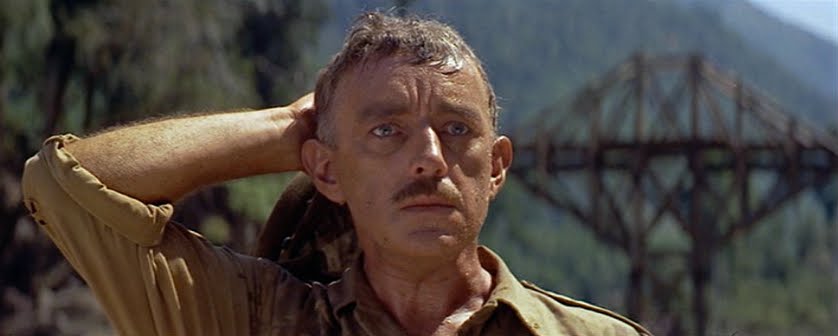
#36: The Bridge on the River Kwai


I'm not entirely sure what qualifies David Lean's 1957 Best Picture winner The Bridge on the River Kwai as an American film, given that its director, its star, its story and the bulk of its financing all came from the United Kingdom. It's even based on a French novel. William Holden is American, but as far as the rest are concerned, there's not much Yankee to be found. In fact, the film places eleventh on a parallel list by the British Film Institute! Its place on a list of great American films is a mystery to me, but the former adjective describes it well enough to qualify it onto any list of great war films.

Company: just me again. I have a hard time finding anyone who will watch a three-hour war movie with me on a beautiful Tuesday afternoon. One of the many quirks about this blog.

Cuisine: fried egg on wheat toast with sliced cherry tomatoes and my mother's bean salsa recipe that I've now perfected. You're welcome. Oh, and plenty of coffee.


The film recounts a largely fictional story based in a factual and horrifying context: the construction of the Burma Railway during World War II. After the Japanese had captured Singapore and had military strongholds in much of southeastern Asia, they built a long railway from Bangkok to Rangoon in order to support and send supplies to the large Japanese army stationed in Burma. As a result, British POWs are marched into an internment camp somewhere in western Thailand, led both in step and in annoying whistle-song by Colonel Nicholson (Oscar winner Alec Guinness), and told that they will be enslaved and forced to build the titular bridge, essentially to aid the enemy. Oh, and there's basically no chance of escape. Major bummer.


"You speak to me of code? What code?!"

All these orders come from General Saito (a fantastic performance by Oscar nominee Sessue Hayakawa), a merciless tyrant with more pride in his work (if that's possible) than the British commander, Nicholson. Two very stubborn men face off: Nicholson hands Saito a copy of the Geneva Convention, which clearly states that all POWs with the exception of officers (hem hem) can be made to do physical labor. Saito throws it to the ground in disgust and snaps Nicholson's stick-thing. Oh snap. Nicholson picks up the papers calmly and stands again at attention, never letting his temper get the best of him. A better man than I, he is.

(Saito also says at one point "All work and no play makes Jack a dull boy," which is also quoted repeatedly by the character in The Shining played by Jack Nicholson, whose last name is shared by Alec Guinness's character in this movie. Connection, to and from!)


But knowing that he and the hundreds in his command have little chance of escape, he has little choice but to hold his ground. As a patriotic and noble Englishman, he has two alternatives: build the bridge and help the enemy, or stand firm and refuse to participate. The latter will bring almost certain death, as is evidenced by two forms of torture, pictured above (standing at attention all F-ing day) and below (being locked in "the oven" without food or water in the scorching sun). His refusal to work and adherence to the Geneva accord locks his generals in ovens, too, while the rest of the men slave away at the bridge, working as slowly as they dare and sabotaging whatever they can.

Although Saito stands firm ("You will not speak to me of rules," he shouts."This is war! This is not a game of cricket!"), he knows that he needs the army's help: if he and those he commands don't finish the bridge by a certain date (here, May 12), he will have to commit seppuku, or ritual suicide. Impass.


When Saito makes up a reason to finally relent (the anniversary of the Japanese victory over Russia in 1905), the real work starts, and the British generals are put back in charge. Nicholson's pride wins out over his patriotism, as he convinces the rest of his soldiers to honestly build a quality bridge, this time with better materials and in a more solid river foundation upstream from where the Japanese commanders chose to break ground.

Meanwhile, one U.S. soldier named Shears (William Holden) manages to escape through the dense jungle, happen upon some compassionate villagers, and send himself on a river voyage, where he contracts some disease or another from drinking river water and is finally found and rescued by allied forces who airlift him to Ceylon (now Sri Lanka). While he's relaxing on the beach with beautiful women and awaiting his return to America, he's informed that he has no choice but to return to Thailand with allied British patrolmen whose mission is to the destroy the bridge. Oops. Back to it.


It's not going real well.

Now we have parallel plots: Nicholson and Saito, coming to a common understanding, unite to complete the bridge, and Shears and his comrades parachute back into Thailand in order to blow it up. The rest of the film documents the inevitable end to which these simultaneous stories come.

Holden turns in a thrilling performance, especially in his "big scene" in which his commanding officer asks to be left behind after an injury:

Shears: "You make me sick with your heroics! There's a stench of death about you. You carry it in your pack like the plague. Explosives and L-pills - they go well together, don't they? And with you it's just one thing or the other: destroy a bridge or destroy yourself. This is just a game, this war! You and Colonel Nicholson, you're two of a kind, crazy with courage. For what? How to die like a gentleman... how to die by the rules - when the only important thing is how to live like a human being."

I feel like this sentiment comes out of nowhere a little -- we're nearly two hours into the film and suddenly the moral comes out? Perhaps it's been there the whole time and we the audience have been too horrified by the injustice to see the simpler universal theme that's buried under everything else. Is it a critique of the nearly insane sense of pride felt by these top officials, a pride that trumps all else, including patriotism, and the sense of right and wrong?


Once the bridge is complete, Nicholson has a quieter epiphany, staring down the river Kwai.

Nicholson: "There are times when suddenly you realize you're nearer the end than the beginning. And you wonder, you ask yourself, what the sum total of your life represents. What difference your being there at any time made to anything. Hardly made any difference at all, really..."

It's a gorgeous monologue in a heartbreaking performance by Guinness. Has it all been for nothing? Not just the bridge -- but the war? His own sense of duty and honor for England? And of course, the best moment of the film...


"What have I done?"

I love Guinness's flat line reading here -- so horrified that it's almost not even a question, but a sentence, a statement of the horror that he's just realized. And the ending, of course, is "madness! Madness!!"

It's interesting to examine the war films placed on this list -- by my count, dozens (even if you don't include atypical war films like The Lord of the Rings: The Fellowship of the Ring, which is a fantasy film but still has plenty of war in it) -- and what they say about America's relationship to conflict. I found several parallels between this film and The African Queen -- not just that our heroes are British, but also the pride and patriotism that directly inspires destruction and vengeance. What does Kwai's inclusion on this list (especially when it's not specifically American in any way outside of Mr. Holden) say about our love of war?

I love when a film inspires me to forge on. And no more war, for at least the next few. Woody Allen's not really interested in that, he's got his eye on one miss Annie Hall, up next.

March 22, 2011

#37: The Best Years of Our Lives


I started this list with a William Wyler film (Ben-Hur) and I might need to see some more of his work (notably Wuthering Heights, Mrs. Miniver and Funny Girl) after watching his only other film that made this list: the Best Picture winner from 1946, The Best Years of Our Lives. Holy cow, I did not expect to be so moved and thrilled by it, mostly because I had very few pre-conceived notions. I knew it won best picture, and that it was almost three hours long. And maybe it was about WWII vets. But that's it. Just goes to show: movies can always surprise you. And sometimes it's better not to know anything going in. The payoff is so much greater.

Company: alone, although of course now I wish I had made this an event.

Cuisine: obscene amounts of coffee. This was a gloomy Monday and yet somehow I was on fire all day focus-wise. Hmm.


Wyler opens on what would have been present-day America: U.S. soldiers arriving back on their homeland after World War II. Three servicemen (Oscar winners Fredric March and Harold Russell, plus Oscar snub Dana Andrews) meet while hitching a ride back to their hometown, the fictional Midwestern hamlet of Boone City, Ohio. Homer (Russell) is the first to get home, and although his family has been warned, it still comes as quite the shock to see that he has lost both arms at the wrist in an accident. His beloved Wilma (Cathy O'Donnell), who lives next door, rushes out and hesitates, like they all have, but embraces him just the same. Somehow the emotion of this reunion had me misting up -- and we were 15 minutes in!


Al Stephenson (March) is the second to arrive home, to his wife Milly (Myrna Loy) and two children, now grown (Michael Hall and the luminous Teresa Wright). There's such overwhelming joy in these reunions we see, but there's something in them that threatens to tip the scale: excitement almost to the point of trepidation and fear of returning, that somehow this domestic life these servicemen knew is now more foreign to them that the battlefield. Hugo Friedhofer's glorious score undersells the schmaltz of these reunions, hinting that this is the happiest these men in uniform will be for a while.

Al finds his wife somewhat distant and his children strangers. "It's terrible to be old, isn't it?" quips his wife, who tries to make light of his absence but ends up separating her husband even further from his family. I guess I expected these servicemen to feel far away because of PTSD, but for them, the true obstacles lie in getting back to everyday life.


The third soldier, Fred Derry (Dana Andrews), comes home unable at first to find his wife Marie (Virginia Mayo), whom he met and married days before he was deployed. He comes home to find he doesn't know her (not that he ever did), and that she's moved out on her own, waiting impatiently for him to come home. If that wasn't enough, his old job as a soda jerk is no longer available, meaning he has to start over from scratch. One bitchy salesman whispers "Nobody's job is safe with all these servicemen crowding in," making it clear that some people aren't so thrilled that the boys are back in town.

The film follows these three men and their struggles to fall back in love with their families, their wives, their girlfriends, and their country, one that owes them so much and at first can't deliver "the best years of their lives," as it were.


The great legacy of the film, I think, is due partially to the fact that each of these three stories is given equal weight, even as their stories give, take from, and weave in and out of one another. Fred begins, by chance, to fall for Al's daughter Peggy as he grows further and further from his new bride Marie. Al has a new outlook on his job as a small loans officer, looking with a fresh eye at the intentions of entrepreneurs. Homer, while adjusting well to life with his new hooks, discovers the crucial things he can't do alone, e.g. putting his harness back on in the mornings, or opening a door in the night without the harness. Each man is changed greatly by war, and the film chronicles their journeys to acceptance of what's changed while (and because) they were away.


Take Fred, whose wife insists he put his Army digs back on to go out on the town. "Now you look wonderful," she exclaims. "You look like yourself. Now we're right back where we started!" Of course, she'd never seen him in civilian clothes, and all through their marriage she'd only known an image of him in uniform. He begins to drift away from her but still feels obligated to stay with her given her sacrifice while she was away. When she and Peggy meet in the powder room while the friends are out one night, Wyler frames them in the above shot as if to say there are two Peggys are work here: the supportive friend and the secretly-in-love-with-your-husband self-proclaimed homewrecker. Love that shot. And the one below.


Has a man ever looked so alone and out of place in his own home? It was around this point that I started to see this film as a good twin to Michael Cimino's The Deer Hunter, which examines recently-returned vets of the Vietnam conflict. In that film (30 years after this one), Michael, Stan and Nick deal more with their own political and moral demons about the nature of war than Al, Fred and Homer, but both films follow each of their three heroes (or anti-heroes, as the case may be) through their own version of post-traumatic stress. It'd be an interesting comparison to examine more.


Of course, The Deer Hunter is mainly a nightmare to the sweet dream of The Best Years of Our Lives, which nearly made me cry -- twice! The second time was the lovely scene pictured above, in which Wilma confesses wordlessly her love for Homer. What could have been a syrupy, sentimental schmooze-fest is tender and intimate under Wyler's steady and visionary hand, a lovely ode to courage and patience. (Also: love the detail of Wilma's portrait on the nightstand, a constant presence even when Wilma herself is not in the room.)


Each story ends happily, but the papers warn of a "new war" coming. It was 1946 and I can't imagine the writers could have anticipated the Korean War a few years in the future, but perhaps we're meant to take away that even the largest-scale conflict of the 20th century could not heal all wounds, that inevitably aftershocks occur. But at least for now, there's a little peace, a deep breath before the plunge. In the last moments one character mentions that life will be a struggle, that it could be years before they can get ahead... so perhaps the titular years are yet to come.

Wow. I just loved this so much. I did not anticipate that at all! My faith in this list is renewed. Or maybe my passion for it is reignited. I'd been nervous that with spring approaching I'd lose interest, but hopefully now I'll have renewed energy to power through the last third of the list.

Up next: one that I've (shamefully) Netflixed and returned without watching. Whatever, you guys have done that too. From 1957, another war film: The Bridge on the River Kwai.

March 15, 2011

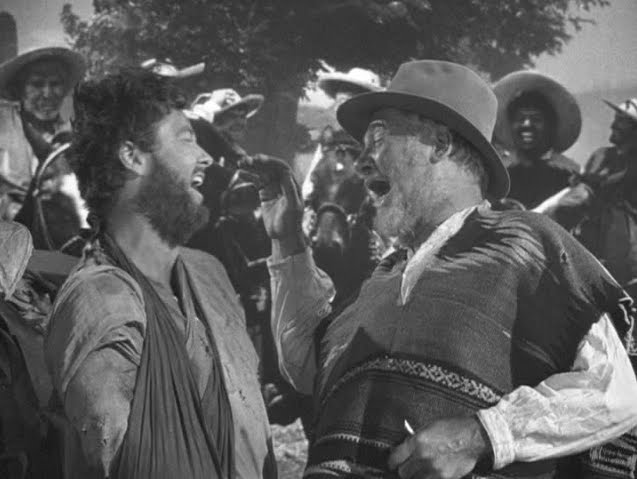
#38: The Treasure of the Sierra Madre


John Huston's 1948 adventure The Treasure of the Sierra Madre is not, thankfully, a Western, as I expected. Yes, it takes place in a time and region adjacent to the Old West (south of the border in 1925), but the story, while chronicling revenge, paranoia and personal destruction, doesn't lump this into that dreaded category. I'm hard on Westerns, but they've given me little but grief! So this turned out to be a pleasant surprise.

Company: Stephanie, moderately interested sister and appreciator of soup

Cuisine: homemade potato soup (hearty! winter! veggies!) and coffee


The basic story goes that Dobbs (Humphrey Bogart, lacking the suave he normally exudes and trading it instead for sneers and scruff), down on his luck in Tampico, Mexico and asking strangers for money or lunch, stumbles upon Curtin (Tim Holt, much the same) and they hatch a scheme to head south in search of gold. Luckily (or unluckily?) for them, they happen to meet Howard (Oscar winner Walter Huston, father to the director!), an old prospector who predicts trouble for them but agrees to accompany them.


Hey, old man -- this is an AB conversation, so why don't you C your wa-- wait, you know about gold??

Danger lies around every corner for our trio -- bandits, huge lizards, thirst, delirium, frustration -- but with Howard's help they finally find... a dusting of gold!!?? Yes, as it turns out, this part of the terrain is not too lousy with gold, and prospecting takes time and patience, the latter of which is particularly lacking in Dobbs.


Howard, the only experienced prospector in the bunch, stays positive and chipper while the others begin to show signs of greed and duress, and seems bemused by their bickering. He also has this habit of dancing wildly just when things get serious. Give the movie some levity and you get an Oscar!


The outside world threatens to capsize their plans when an intruder (Bruce Bennett) follows them up the mountainside one day and demands inclusion in the scheme, threatening to expose them to the town and alert the locals to their presence and stash. He knows the men can just kill him, but warns that his execution will start a hierarchy of distrust among the prospectors. The logic is messed up but nonetheless, we start to see the men, especially Dobbs, weigh their gold against their own skewed moral conscience. Gold messes you up, you guys. Bandits invade and famously "don't need no stinking badges" (who knew?), disposing of the intruder. But the seed of distrust among the men has been planted with or without that threat to their gold.


Humphrey, you got a little crazy on your face.

When Howard is called away to help some nearby villagers (?), it's Dobbs v. Curtin at the campsite. Greed, paranoia and gold-blindness take over -- and without spoiling too much of the ending, let's just say that in its own way, The Treasure of the Sierra Madre has a lot to say about materialism in our culture.


Have we learned anything from the moral of this film? Or is longing for riches something inherent in us in a capitalist society? Shouldn't we be able to make something out of nothing, to make riches appear out of nowhere and claim ownership over them? Reading the Wikipedia entry about this film, I found that P.T. Anderson watched this film to prepare for filming There Will Be Blood, another prospector film (this time oil replaces gold) about a man whose greed destroys him. Maybe it's timeless, the insatiable need for wealth. Is that an American trait, or a human trait? Are we presumptuous to assume that striving to obtain riches beyond our need is a specifically American hunger? I think maybe.


Well, laugh it off, chumpies. Ob-la-di, ob-la-da. Not a lot to say in the way of film critique here -- it's ably (and Oscar-winningly) directed and acted, but the moral truth of it is what sticks with me. In light of this weekend's devastating earthquake and tsunami in Japan, I'm seeing that all the gold in the world, metal or otherwise, can be taken away in the blink of an eye. Let that be a lesson to you all! /preach

Next up: another in a series of films I know little about. Isn't that what I was excited for in this list? The Best Years of Our Lives. We'll see if it is. Spring is approaching and I've gotta get moving on this blog, because heaven knows this summer will be spent almost entirely outside.