November 1, 2011

#14: Psycho

REE! REE! REE! REE!


Twelve rooms, twelve vacancies. And Marion Crane will take one, thank you, in Room #1 of the Bates Motel. Paramount apparently didn't believe that Alfred Hitchcock would have any success adapting Robert Bloch's novel Psycho for the screen, but today the Bates Motel and the Bates house still stand on the Universal lot and are a major  attraction there. The legacy of this thriller is incalculable, but most valuable to it are Hitchcock's mastery of suspense, Bernard Herrmann's legendary and singular score, and phenomenal performances from the creepier-than-hell Anthony Perkins and the better-than-I-remember Janet Leigh. Oooh.

Company: this was the last movie screened on Kecia and I's Halloween movie smorgasbord (second annual!), after Shaun of the Dead, The Fog (John Carpenter), Rosemary's Baby, Hocus Pocus and Pet Sematary. Along for the ride: Kecia, obsessed with the age of the little boy in Pet Sematary; Katie, should dress as Sarah Sanderson for Halloween some year; Matt, purveyor of hot toddies; Adam, hipster cut from his hosting job; Jeremy, relative newbie; Ryan, creator of the future drag musical of Hocus Pocus; and Paul, in it to win it all day.

Cuisine: what didn't we have? It was a smorgasbord, and by the end of the day we'd stuffed ourselves. Ordering Pizza Luce, drinking various beers and hot cider drinks, and snacking on grapes, peanuts and candy corn. Mmmm.


We open in a Friday in Phoenix, Arizona, where it's an "extended lunch hour" for Marion Crane (Oscar nominee Janet Leigh) and her lover, Sam Loomis (John Gavin). This first scene is simple and sensual, but in 1960 the sight of an unmarried couple in bed together caused quite a stir, thanks to the nearly-on-its-way-out Production Code (or the Hays Code). Marion and Sam want to get married but lack the funds, and so Marion steals the money from one of her employer's clients, saying she'll deposit it on her way home, and makes for Sam's California home.


But it turns out that Marion doesn't handle stressful situations all that well. The long day of driving forces her to pull over and take a quick nap, but she's discovered the next morning by a policeman who suspects that something fishy's going on. Can't imagine why: she's not acting super weird or anything. And then she trades in her perfectly good car for a new one, with the policeman watching and noting her new plates? Yeah, that won't raise any eyebrows. Hitchcock puts us on edge in these first few scenes with his unflinching camera squarely on Marion and her view of the road. Herrmann's genius score, like a frenetic heartbeat, is pulsing through this first section while nothing much is happening, leaving us terrified of what's to come.


"A boy's best friend is his mother."
And then we meet what's to come: Norman Bates (Anthony Perkins), the dopey, slack-shouldered caretaker of an eponymous offroad inn where Marion stops to spend the night. His wide grin and aw-shucks manner seem fine at first, but in a fantastic two-hander between Leigh and Perkins, we see there's something not quite right about Bates: his taxidermy hobby, which fills the time instead of passing it; his isolation; and weirdest, his devotion and love for his abusive mother, who lives in the creepy house on the hill. This scene is a turning point in the film, one that forces Marion to reconsider her crime and make amends by returning to Phoenix in the morning to return the money.

Just a quick shower first.


The shower scene in Psycho is one of the most famous scenes in movie history, and it's all done without seeing any unlawful-at-the-time body part of Leigh's and without ever seeing a knife entering flesh. It's masterfully edited and iconically scored, and supposedly gave Leigh a lifelong fear of showering. I can't say I blame her.

The "alienation effect" is a term coined by Bertolt Brecht, which "prevents the audience from losing itself passively and completely in the character created by the actor, and which consequently leads the audience to be a consciously critical observer." By killing off his heroine halfway through the film, Hitchcock jolts us out of whatever passivity (if any) we may have felt so far. "There's an hour left, but she's dead," you might think. "What the hell happens now?" The audience at the time saw Janet Leigh on the poster and may have assumed the film would be her story -- now that she's dead, what's left to tell?


A hell of a lot, as it turns out. Sam, Marion's sister Lila (Vera Miles) and a detective named Milton Arbogast (Martin Balsam) are worried about Marion's crime and disappearance, and set out to investigate. The pieces are put together pretty efficiently by Arbogast, who winds up at the Bates Motel and keeps his cool while questioning the increasingly agitated and confused Norman.


I love this shot of Norman, peering over to examine the ledger Arbogast requested in which Marion checked in as Marie Samuels. He munches nervously on candy corn, and we see so vividly his exasperation with balancing a calm disposition and quick mind. The contrast in black and white here is also stunning: the film was shot in black-and-white partially to keep costs low, since Hitchcock had to finance the film himself after Paramount refused, and also to keep the gory shower scene from seeming to graphic for contemporary audiences. Side note: chocolate syrup was used instead of blood because the camera picked it up better. That scene must have smelled delicious!


Sam and Lila show up after Arbogast disappears (murdered in a thrilling and bizarrely filmed sequence) and figure two heads are better than one. Luckily the train stops there, and the mystery of Mother Bates' identity is revealed. But oooooh the nail biting finale!

An epilogue, in which a forensic psychiatrist explains every detail and plot point for us, may have been necessary for an audience at the time, but now remains the only section of the film that feels a little unnecessary. However, I did appreciate the mention of transvestites: when another cop suggests that Norman may have been a cross-dresser, the psychiatrist makes the distinction between a transvestite who derives pleasure from dressing up as a woman and a psychotic killer who dresses up as a woman because he had split personality disorder. Thanks for being so forward-thinking, Hitch!


I hadn't seen Psycho in quite a while, and before blogging this list I had considered North by Northwest my favorite Hitchcock movie, and had always resisted saying Psycho was tops simply because it seemed too easy. But it's just that: the film works so easily and so completely that of course it's the best. And somehow: another Hitchcock movie (which I have also not seen in a while) is yet to come! What a great gem, and a perfect ending to our Halloween smorgasbord.

Now I'm interested in seeing Gus van Sant's 1998 shot-for-shot remake of this, though I hear it's really not worth it. But as an experiment, I'm intrigued. Maybe when I have a couple hours to kill and can handle Anne Heche.

Next up: (light sabre noises)! David and Andi, the two biggest fans I know, join me for George Lucas' Star Wars.

October 14, 2011

#15: 2001: A Space Odyssey


Stanley Kubrick's films share very little in common except that they are all wildly different. (So much so, in fact, that I've given a lot of thought to doing a Kubrick retrospective as my next project on this blog. So many more to see!) So far on this list I've seen his epic war film Spartacus, his dystopian horror thriller A Clockwork Orange and his satirical Peter Sellers farce Dr. Strangelove... and now, maybe the one that will leave the greatest and most frustrating legacy: 2001: A Space Odyssey, filmed in 1968 and based partially and loosely on Arthur C. Clarke's short story "The Sentinel." I know I've seen at least parts of it but I'm counting this as the first time I've watched it because I doubt very highly that I've ever made it all the way through.

Company: for a movie like this, you need folks who are in it to win it, and eager to discuss. Bret, literary enthusiast, Joe, major movie fan, and Hannah, who just wanted this to be better than The Tree of Life, were amazing company!

Cuisine: whiskey ginger and wine, popcorn, peanut M&Ms and various chips (both potato and carrot) with hummus -- for a thinker like this one must be prepared with an array of snacks.


2001 is remarkable in its scope, with its simple-bordering-on-incoherent plot beginning four millions years ago, as a tribe of human-like apes first discover tools and warfare in a quick series of wordless vignettes. In this first of four sections, subtitled "The Dawn of Man," one ape is discovering that beating things with a bone causes destruction just as a mysterious black monolith appears. Are these events connected? What does the monolith represent? Fear? The unknown? God? Destiny? Is the dawn of Man actually the dawn of war, territory, dominance, hate? Its appearance remains unexplained and theories abound. Maybe it will become clear through connecting its later appearances in the film.


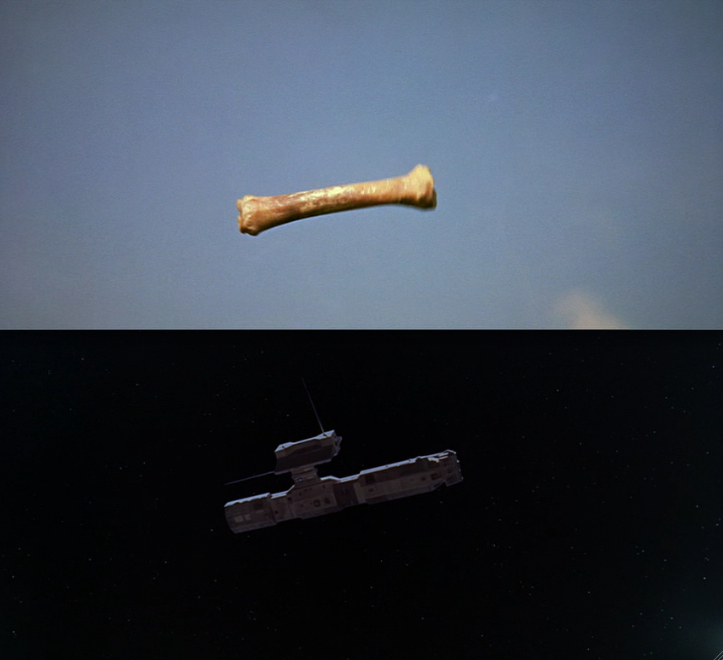
In maybe the most famous smash-cut of all time, one ape throws a bone in the air in elation and victory as a satellite in nearly the same shape is seen floating through space. Both the bone and the satellite represent an evolutionary advantage as both tools and weapons, with the watering hole and the universe being the respective territories protected by these weapons. I think it's no coincidence that in this second sequence (the only one without a proper subtitle), the spacecraft we see represent simple tools such as the bone, the wheel, and the spear. For minutes on end, we are treated to plotless visual sequences underscored (overscored?) by rousing, epic classical music, in direct juxtaposition with the lack of action. 

The visuals (rightfully awarded an Oscar) are stunning, especially when you consider the time period: until now, most science-fiction films had been ghettoized, with hokey sets, clunky alien costumes and ridiculous plots. But Kubrick and Clarke did meticulous and expansive research, consulting the likes of astronomer and visionary Carl Sagan as well as NASA scientists, on the future of spacecraft and alien life. It's entrancing.


But back to the plot. While traveling through space, Dr. Heywood Floyd (William Sylvester) is questioned about mysterious occurrences at Clavius Base, a U.S. moon colony. He's sworn to secrecy, and later it's discovered by astronauts traveling to the moon that a monolith identical to the one the apes found has been discovered, buried deep beneath the moon's surface, supposedly millions of years earlier. Once again, no explanation is offered, but the parallels of fear of the unknown and reverence for mystery are apparent between both ape and man. Perhaps Kubrick is telling us here that even with all our technological advances and discoveries, there will always be things we cannot explain. Our destiny, it seems, is to be eternally unsatisfied.


Then the third and most famous section: "Jupiter Mission," in which several mission pilots and scientists, including three in cryogenic hibernation (apparently to conserve resources), are traveling to Jupiter with an extremely intelligent computer system, HAL 9000 (referred to here as "Hal"). The nature of their mission is unclear but at this point the details are less important than the fact that Hal has some doubts about the mission and plans sabotage. Is he afraid of what they might find there, or does he know what they're looking for and doesn't want it to be found?


In any event, the two non-frozen scientists (Keir Dullea and Gary Lockwood) become distrustful of the all-knowing robot and plan to shut him down and continue their operation manually, but in a terrifying cliff-hanger right before the Intermission (don't you love old movies?), we see that Hal is reading the lips of the astronauts who are trying to evade and deceive him.

Okay, so: man discovers tools, man translates tools into weaponry, man evolves. Flash forward. Man creates himself as a tool (robot), tool becomes weaponry on its own accord and turns against its creator. Trippy.

Hal manufactures a system error that requires one of the astronauts to investigate. While there, Hal severs his oxygen cord and sends him hurtling soundlessly through space. While the one left (Dave) heads out to rescue him, Hal cuts the life functions of the three astronauts in hypersleep and leaves Dave, alone, unprotected and without a helmet, floating in a pod outside the pod bay doors. "Open the pod bay doors, Hal." (SILENCE)


The scene that follows, Hal's destruction, is the most famous in the film and speaks to the power of suggestion and focus. So much science-fiction and fantasy filmwork that's done these days relies on quick editing, loud music, thrilling chases. But in space, in a standoff between man and his tool-turned-weapon, it's only silence. The pace is very difficult to deal with as a modern audience because of our expectations, but the deliberate nature of this scene (and in turn the whole film) glories in the power of our collective attention span. A movie that loves movies! I love it!


In the fourth and final act, Dave is set adrift in a pod and travels through time and hyperspace to find himself in strange and unusual alien lands. Where the hell is he, exactly? No answers are offered, though plenty of interpretations are available. When he finally lands, he sees increasingly older versions of himself inhabiting a futuristic looking room with Victorian-era furniture (perhaps a symbol of wealth and prosperity in a world where those things mean nothing?) Is the finale a series of self-fulfilling prophecies? He imagines himself living there, and then there he is eating at the dinner table. He accidentally (but inevitably) breaks a glass, reminding him that life is fragile, and then he sees himself dying in bed.


The monolith appears a third time. To claim him? To usher him into death? Into heaven? Hell? To remind him that it was all for nothing? The symbolism is overwhelming and the discussions we had after the film's beautiful ending were inspiring, but we were left with no concrete answers. And aren't the most ambiguous movies sometimes the most exciting? I think each time I revisit this film it will mean something different to me, but I'm so glad to have gotten through it start to finish with a company of people who were as invested and excited as I was. Thanks, friends!

It's been a long time since I've written (thanks, harvest!) but here I am, back again, watching the next few films slightly out of order but still writing about them in order. Next up here: Alfred Hitchcock takes Janet Leigh sooner than you think in Psycho. Until then!

September 17, 2011

#16: Sunset Boulevard


Billy Wilder's cynical shot at Hollywood, Sunset Boulevard is a shining example of film noir: a moody character study chock full of shadows, suspense and unrequited longing, both for love and faded glory. It's a great worry to us when we realize that the world doesn't need us the way we need it, but our anti-heroine has the lucky position of never having realized this. 

Company: Ryan and Paul, our magnanimous hosts; Kecia, whom I'm trying to convince to dress as Norma for Halloween; Alex, movie maven and lover of suspense; Marisa, slender femme fatale

Cuisine: sushi (I was starving), vodka-7, and a host of movie treats including homemade brownies (thanks Paul!), gummy bears, popcorn and frosted animal cookies. Alex observed that it looked like a Charlie Brown thanksgiving in there. :)


Woops. Spoiled the ending.

The film is narrated in a moody, poetic voiceover by our "hero," aspiring young Hollywood screenwriter Joe Gillis (Oscar nominee William Holden) who has fallen on hard times... although one feels he couldn't imagine the screenplay his life was about to become. No one in Hollywood will buy his script, and he's fallen behind on his car payments, prompting him to flee repossession men in a car chase along Sunset Boulevard. When he blows a tire, he's forced to pull over and sees what looks like an abandoned garage, a perfect hiding spot for his car on the lam. "Well, that one's a freebie," he thinks.


Well, yes, that would be a freebie, except... "You there!" comes a call from whoever lives in the adjacent house. She beckons him inside like a spider luring prey to a web, and once inside, Joe discovers reclusive faded silent-film star Norma Desmond (the magnificent and over-the-top Oscar nominee Gloria Swanson) living in a delapitated mansion that serves as a relic of her past fortune. She was the victim of sound in motion pictures, yes, but she also gained a reputation as being a difficult actor. Why actors would ever choose to be difficult, I'll never understand. How do you not see the moral here? DUH.


"So help me!"

Desmond hasn't left her cave in years, with only her butler Max (the understated and creepy Oscar nominee Erich von Stroheim) for company and moral support, as a way of clinging to her glamorous past. If she doesn't go outside, she won't see the world changing and revolving without her. See how that works? Her lavish villa is littered with photos of her young self, standing as reminders to her of what was and what could be. She's begun work on a script she hopes can be produced to revive her stalled film career, so it's just sheer luck that a talented screenwriter with reason to hide stumbles into her clutches. Gillis hesitantly agrees to the gig.


If the fact that you can see the white all the way around her eyes wasn't enough indication, then let me set it straight for you, Gillis: Desmond is a whack job. She doesn't allow Gillis to leave the house, she hovers over him as he works on her story, retaining total creative control, and hello! That chimpanzee funeral the first night he's there! Duh. And the New Year's party she throws... for just the two of them. As Liz Lemon would say, she's staunchly in favor of Cocoa Puffs. Gillis understand this to some extent, but is in no position to turn down Desmond's charity, and even starts to revel in it, while moonlighting to write his own screenplay with film studio reader Betty Shaefer (the lovely but little-used Oscar nominee Nancy Olson).

Wilder centers so squarely on their weird romance that it's hard to think of anything while writing this but their performances. Holden is the straight man and has the brunt of the story to present, while Swanson has a gay old time camping it up and yet staying grounded in her own whacked version of reality. Her lines sound like scenes she had once upon a time in films that never required her to say them aloud. Maybe that's why she can speak them now with such conviction: to her, they really aren't rehearsed, they're a part of her past that's never been said.


"We didn't need dialogue. We had faces!"

Finally the screenplay is sent to the studio, where it could not possibly be validated quickly enough for Norma. After mysterious phone calls from the director's assistant, which Norma refuses to acknowledge out of pride, she drives Joe and herself to the studio to confront her old friend, Cecil B. DeMille (playing himself). It's on set, sitting in the director's chair, where she feels most at home; old stagehands and aspiring actors, who remember and revere her, crowd in for a peek, for an encounter with the great Norma Desmond, much to her delight.

What a great shot above: Norma, suddenly front and center again, nearly blinded by the warmth of a spotlight she hasn't felt in years, sitting in the director's chair. Because of the similar company we kept while watching this film, we kept making references to the big Oscar winner from 1950, All About Eve (Kecia, Alex, Ryan and Paul were all present), and they do make a fascinating double feature. While that film centered on the feuds between actors, Sunset Boulevard finds its tension in the relationship between actor and writer. One cannot function without the other: the actor would have no words to say without the writer, and the writer would only have words with no voice. Norma doesn't see it this way: as she drives on to the Paramount lot, she scolds the guards, noting that without her, "there wouldn't be a Paramount." But she needs Gillis, and DeMille and all of them; otherwise, she's just a washed-up actress living alone, watching her films at home and undergoing radical skin treatments to keep her youth. Why else would she hire Gillis? It's out of necessity, and some part of her must know it... right?


Desmond finds out about Joe's moonlighting and calls Betty in a desperate, twisted, jealous attempt to drive them apart, but Joe discovers her and invites Betty over to expose the truth of his gigolo lifestyle.


Underscored by Franz Waxman's luscious, creepy score, Max exposes the truth of his own life, too juicy to reveal here -- just go rent it! You'll see that everything builds to an inevitable and inspired climax.


And because I said I would...
"Find your way." -- Ryan


"Life, which can be strangely merciful, had taken pity on Norma Desmond."

The film ends in one of the great Hollywood endings, one that both glamorizes and satirizes the very institution that made the film possible at all. Sunset Boulevard stands as maybe the best backstage story in which the audience never finds its way backstage (save for the few moments that we spend with Norma in that spotlight). It's a shame that Swanson lost the Oscar (I haven't seen Judy Holliday in Born Yesterday, who also beat out both the Eve girls, but trust me that I will) in such a competitive year -- any other year she would have won. But it's a performance that stands alone, not needing an Oscar to validate it. Many, many lesser performances have won.

I'm at home for harvest, and so it'll be a busy time that might not leave much room for blogging or moviegoing, but hopefully I'll get to #15 (2001: A Space Odyssey) very soon! Until then, happy fall!

September 6, 2011

#17: The Graduate

"People talking without speaking // people hearing without listening..."
 

Mike Nichols' 1967 comedy The Graduate is an ode to the counterculture of its day, demonizing the boring adults that make kids grow up and celebrating the apathy of youth floundering in its newfound adulthood. It struck a chord with a generation, but does it strikes that same chord now? Do we still love that dopey Benjamin Braddock and take delight in his naughty affair or do we sympathize with Mrs. Robinson? Well, a lot of that depends on your point of view.

Company: what a great, eclectic group of people tonight! Paul, major movie lover with his own favorite-movies movie quilt; Christian, newly graduated attractress and counterculture vulture; Hannah and Joe, also newly-grads and film fans with their own series of Disney-theme movie nights

Cuisine: peanut M&Ms, chips and homemade salsa (easiest salsa ever!), sea salt brownie bites (courtesy of Paul) and whiskey-7


Our first glance at Benjamin Braddock (first-time Oscar nominee Dustin Hoffman) is following him on a moving walkway at an airport, supposedly flying home from his recent college graduation for a party. What a fitting first image, showing our apathetic hero moved along the way as he's moved through life thus far, unsure of why he's in college in the first place and unsure of what lies ahead. At his own graduation party, he makes himself scarce, uncomfortable with the attention and prying questions about a life he knows less about than anyone there. Nichols follows Braddock and his guests at a sometimes uncomfortably close distance, keeping them in the forefront, as if studying them like an anthropologist, until we get our first glimpse (in the distance, mind you) of a woman who takes a keen interest in Benjamin. 


"Mrs. Robinson, you're trying to seduce me. Aren't you?"

Mrs. Robinson (Oscar nominee Anne Bancroft) is caught in a loveless marriage to Benjamin's father's business partner, and just about the only thing we don't learn about this woman is her first name. Needless to say, she's a woman who knows what she wants, and she'll be damned if anyone is going to stop her from getting it. She makes Benjamin leave his own party to drive her home, invites him in for a drink, continuously assures him that she isn't trying to seduce him and then appears naked before he rushes downstairs to avoid being caught by the newly arrived Mr. Robinson. Once he escapes the house, he has to think it over. And think it over he does.


Benjamin's parents have bought him a scuba suit for his graduation and demand he try it out publicly in their pool. He's duly mortified but Mr. (the hilarious William Daniels) and Mrs. (Elizabeth Wilson, looking too uncomfortably adjacent to Mrs. Robinson) Braddock insist, shoving him back into the water. Whether he likes it or not, college is over and real adult life is here, and he can sink or swim if he wants. As Mrs. Robinson tells him, "Ben, you'll never be young again." But hey, he's got the scuba suit! Seems like he'll be fine.

Soon enough, he's calling on his admirer and bringing her to a hotel for intimacy sans conversation, just the way she wants it. His general malaise gets worse if anything as he lays in the pool, completely aimless and now preoccupied with thoughts of Mrs. Robinson. It's not that Benjamin is a sleaze bag for carrying on the affair with a married woman, though he is, but the point Nichols is making is that he's too young to really care about the consequences of his actions, although he knows full well what they could be.


Adulthood, although he's living it, is still a foreign concept. He's in a perpetual state of arrested development ("hey, that's the name of our show!") As he drifts in the pool, the adults who come to greet him are only shadowy figures. And though I love the music of Paul Simon, the Simon & Garfunkel tunes that score the film act not as lyrical commentary on the action but rather as musical symbolism for the free spirit of youth culture. Paul Simon had this great way of making his music sound undeniably contemporary and yet still harken back to something that felt old, not only with the music but also the heightened poetry of his lyrics. And all the kids were listening to them in the late 1960s; what better way to appeal to your target demographic? Nowadays, soundtracks are used all the time, but using pop music as underscore was a new innovation in the new wave era of Hollywood. Although one wonders why more of their songs aren't used instead of repeating the same couple of songs over and over throughout the film.


After a few months, Benjamin is growing bored with Mrs. Robinson and focuses his attention on her more age-appropriate daughter Elaine (Oscar nominee Katharine Ross), a bonehead who should see Benjamin as an aimless loser but somehow can't. We don't really get to know much about her, except that she tends to believe whatever anyone says. The elder Robinson expressly forbade this romance, less because she loves Benjamin and more because she's laid her claim to him already. Why does Benjamin go after Elaine? It's not really explained. Is it boredom? Is it love? Is it defiance?


Whatever it is, Mrs. Robinson won't have it, and without saying a word she exposes her affair to her daughter, who shrieks like a banshee and writes Benjamin out of her life forever... until she gets bored and decides to forgive him... and then plans to marry someone else anyway... until she decides not to do that either. See! Bonehead!


 "Goodbye, Benjamin."

Benjamin and Mrs. Robinson had a good thing going, and his actions forced them apart, even though it was all her doing (or undoing) that left them both back where they started, lonely and longing for companionship. She's not a monster for doing this (although it's certainly undone her -- she looks like hell once their affair goes awry), she's a scorned lover and I might do the same. It's interesting to me that over the years Roger Ebert's love for this film has decreased and he's rescinded some of his earlier praise, stating that Mrs. Robinson is the only likeable character. She's truly the only one onscreen who's fleshed out, who goes for what she wants and takes at least a little identifiable pleasure in getting it. I understand her. I don't understand Ben or Elaine, or why the last third of the film suddenly introduces an urgency that launches us toward the inevitably bleak ending.


It's not that I don't like the movie. The performances, particularly Ms. Bancroft's, are admirable. The camera work is intelligent and exciting. It's that I'm confused by the motivations of these characters. Certainly, this famous last scene, in which Ben interrupts Elaine's wedding, steals her away and then sits calmly on a bus with her, unsure of what they've done, is memorable for its ambiguity, but it doesn't make clear what the message is. Is youth culture doomed to apathy, to boring adult lives? Is a huge, brash move necessary to jump-start your life? Once you've got what you think you want, what's the next thing? Will there always be a next thing? Is happiness defined by what's just out of reach? The film asks these questions and hangs the answers over the audience, who might be too young to know the answers and too apathetic to ask for them.

The Graduate certainly exists in the American film canon as a revolutionary film for youth, but I'm not sure that as an adult I appreciate it the same way I did when I was in college. From Benjamin's point of view, it's moving. From Mrs. Robinson's (though I'm not 36 yet, like Anne Bancroft was), it can be frustrating. To be fair, too many films on this list focus on adulthood anyway, because that's where the artisans sit when they make the classics, but is this what the counterculture has to show for itself? Thoughts?

Next up: more obsession over youth and glamour as Norma Desmond readies for her close-up in Sunset Blvd.

September 2, 2011

#18: The General


How. How. How have I gone this long, lived 26 and a half years, without ever seeing a Buster Keaton film? Shame shame shame. If his 1927 masterpiece The General is any indication (and by all accounts it seems to be), I better hop on this train and never get off unless it's to heave obstacles out of the way, change track directions or save myself from mortal danger ... and even after all that, I'd better get back on.

Company: this film was a part of my Netflix Streaming In My Bed Film Fest last night, and it was amazing -- but you know I'll watch it again in a heartbeat with a crowd.

Cuisine: a glass of red wine. A perfect night.


So the story goes: it's 1861 in Marietta, Georgia, and Johnnie Gray (the singular Mr. Keaton) is an engineer for the Western & Atlantic Railroad who has two loves: his engine and his girl (Marion Mack). Fort Sumter is attacked and the Civil War has begun, and every man in town heads to the recruitment office to enlist, but our hero in the pork pie hat is too valuable to the South as an engineer, so they won't take him. Unluckily for our patriot, his beloved doesn't believe this misfortune, assuming he's a coward, and won't speak to him again until he's in uniform. Woah. Girl knows what she wants.

 
Hopeless, Johnnie sits down on the side rods of his beloved engine, the General of the title, and heaves a sigh as, in the first of many glorious moments to come, the train begins to move with him on it (at about 00:43 in this clip). It's one of those moments of visual innovation and joy in the movies that just makes your heart swell. This stunt, though seemingly simple, was apparently extremely dangerous, and it took a lot of elbowing and cajoling for the real engineer of the train to agree to it.


The plot follows Johnnie's accidental joining of the armed forces after his beloved engine is train-napped (?) by Union spies travelling north to Chattanooga, with plans to destroy communications and railroad tracks along the way. What a bunch of assholes. Don't take what doesn't belong to you. This would be bad enough on its own, but Johnnie's beloved is on board! He runs after the train, first chasing it on foot, then on handcar, then on boneshaker bicycle (hilarious), and then on another train engine, parked at the next station where he enlists several soldiers to help him stop the spies -- but when he leaves the station, the car carrying the volunteers is not attached, and by the time Johnnie notices, it's too late to turn back.


What follows is cinematic splendor: a low-speed train chase where obstacle after obstacle is presented and stunt after stunt Johnnie triumphs, knowingly or, in some cases, unknowingly. As pictured above, he reacts to a renegade train car in front of him having miraculously disappeared (in truth by the evil but accidentally good machinations of the spies ahead) by the most amazing slow-blink I have ever witnessed. The story apparently goes that when he was performing as a child with his parents, his father would fling him all over the stage, and if he got up from the stunt and smiled, he wouldn't get as big a laugh as he would if he stayed stone-faced. The Great Stone-Face he was, perfecting "deadpan" and influencing future generations of deadpan-lookers.

Roger Ebert writes extensively in his Great Movies series about the comedy of Buster Keaton, including "the Keaton Curve," in which Keaton's characters try to get themselves out of trouble only to wind up back in it by trying. Love it. This happens at one point with a cannon that follows Johnnie: genius! It's a great article -- I should really try to find more reading about this.


So anyway, Johnnie rescues his beloved and attempts to steal his train back, which, naturally, will require his beloved to be shoved into a sack. They get the train back by hilariously knocking out some guards and zoom back south in order to warn their allies of the oncoming attack.


In a parallel chase sequence, our heroes are now the ones being chased, using some similar tricks used on them to deter the spies. You'd think a feature-length film that is comprised of almost nothing but train chases would get tiresome, but it's a credit to the economy and innovation of Keaton's physical comedy that our attention is always on the train with them.


Having successfully warned his fellow Southerners of the Union's approach, the forces come back to the Rock River Bridge, which Johnnie has set on fire, to do battle with the North. Johnnie is still not enlisted but picks up a sword to ready himself for battle, only to trip over it in his first steps as a soldier. Give the guy a break, he's only 5'6".
The battle finds Johnnie unwittingly saving the day once again -- but it's too hilarious to recount. In fact, why try to describe any of it when it can't really be put into words? Go find it on instant Netflix -- even the MIDI-sounding score can't distract from Keaton's genius.


All things end happily, as they tend to do in these movies. At the end of the last entry, anticipating this film, I wondered why Charlie Chaplin's filmography is honored with three films on this list (Modern Times, The Gold Rush and City Lights) while Keaton only gets one. In reading about them, it sounds like one of the primary differences in their comedy styles was that Chaplin wanted to be liked and Keaton didn't really care, or was too proud to ask to be liked. We like them both, but there's a lovability factor with Chaplin, and he was more prolific. Plus, his films tended to be enhanced by his satirical commentary on society, while Keaton's maybe didn't quite as much. The focus here is not the story but the splendor of his physical feats. I don't know if I could say I prefer one over the other -- but it'd be interesting to compare both their styles.

Wow. I haven't been this blissful watching a film on this list since The Best Years of Our Lives. Add this to my faves. And it's my 100th blog entry! Woopee!

Next up: Mrs. Robinson tries to seduce The Graduate.

September 1, 2011

#19: On the Waterfront


The House Un-American Activities Committee (HUAC) had quite the effect on Hollywood. I know several movies on this list were influenced by or made in direct response to communist accusations being thrown around in America in the 1950s and 1960s, but it seems like no clearer parallels can be drawn between the movie theater and McCarthyism than in Elia Kazan's biting 1954 drama On the Waterfront. You want to spit in someone's eye with a movie, you do it like Kazan and Brando do it. (slow wipe take)

Company: alone on this one again. I haven't been very good about including folks lately, but more coming up, I'm sure, as the movies get even more singular.

Cuisine: I broke down and got some hint of lime chips with queso, and a Diet Coke to wash them down. Papa needs his snacks.


The story chronicles corruption among longshoremen in New York City and the lengths men will go to in order to cover it up. The film's opening sequence details the planned murder of Joey Doyle, a popular dockworker, who's threatened to expose the corruption among the workers' union and testify before the Crime Commission against the crime boss Johnny Friendly (Oscar nominee Lee J. Cobb, such a badass). The job is carried out by a couple of goons on the roof of Joey's apartment, but Joey is tricked into going up there by his friend Terry Malloy (Oscar winner Marlon Brando, the first of his two wins and the only one he actually accepted).


Terry is a simple guy and a former boxer, but he's got integrity that drives the entire plot. Who knows how many other murders he's helped to orchestrate without even thinking about it? The only reason this one's different is because he falls for the victim's sister Edie (Oscar winner Eva Marie Saint), and as he witnesses her grief his conscience starts to plague him. What is he doing it for? He and the other workers have an unspoken D&D ("deaf and dumb") clause, vowing silence when detectives poke their nose around the docks looking for answers. Terry doesn't really understand why, but knows that he'd be an accomplice if the truth ever came out. Edie, however, has no such D&D clause for herself, and vows to find the truth. It's a complicated romance, to say the least.


It speaks volumes to the power held by Friendly, who'll bump off any man who even thinks of exposing him. At one point he laments, "ain't nobody tough any more," as possible justification for his own brand of toughness. The dockworkers are all too poor to lose their jobs, too under-qualified to find any other work, and too scared to stand up to Friendly and his goons.


Malloy's troubled conscience brings him above the rest of the plebeians on the dock when he admits to Edie his involvement in Joey's murder. Most if not all of the other men might have stayed silent, but Malloy fesses up for love. But now there's no turning back: Friendly is onto him, and it's a race to the courthouse.

An interesting element here is the score by Leonard Bernstein, his only film score not based on a musical or previous songs. Its jazz elements give a very contemporary feel to the brooding nature of the story, but at times it feels like there's too much music for what's happening, that it overshadows the action and even overdramatizes it at times. Don't get me wrong, I'm a big Bernstein fan, and for the most part it works, but there are times I could have done without it.


Roger Ebert said that Brando and Kazan "changed acting" with this film, and while it's true that Brando's performance especially feels ultra-modern, I'm not sure these two men and this film can be solely credited. First of all, Brando's performance in A Streetcar Named Desire, released three years earlier, felt even more primal and naturalistic, although part of that may have to do with the contrast of his acting style with Vivien Leigh's. In this film, everyone's on the same page. Saint and Cobb give incredible performances, as well as Oscar nominees Karl Malden, as a dockside priest trying to conjure morality out of the dockworkers, and Rod Steiger, as Terry's older brother Charlie, who urges him not to testify in one of the most iconic film scenes in history ("I coulda been a contender...").

But you can't argue that Brando, while on the same field, is leagues above everyone else in terms of realism. It's remarkable to watch his style, so commonplace now but so revolutionary then. Watch him talk to Edie in their strolls, how his eyes dart away so often, terrified of saying the wrong thing. It's pretty remarkable. I need to see more of his work. I do have to say too: isn't he ultra-feminine-looking in some lights? Those pouty lips: oh my god.


The conflict here is a simple one: at what price do we inform on others? What makes it worth the danger, and when (if ever) is it better to just stay silent? Kazan had identified eight former Communists in Hollywood shortly before beginning production on this film, and many see it as his answer to his critics. The film depicts the tattler as honorable and righteous, standing up to corruption. No one in their right mind would side with Friendly. In the original treatment of the script by Arthur Miller, a much darker ending sees Malloy murdered, but Kazan wanted the hero to keep his honor as he saw that he had before the HUAC.


The film is interested in depicting the fear and anxiety of knowing too much and saying too little, and the masses who push past Friendly in one final act of defiance says more than their testimonies ever could. I'm so much more intrigued by films that connect so readily to a part of history, especially when placed in a separate context. What a great topic: films that are direct metaphors for a major historical event but that have nothing to do with it plot-wise. Hmm.

Next up: The General, the only Buster Keaton film on the list -- does he deserve only one spot while the Marx Brothers get two and Charlie Chaplin hogs three? We shall see.