July 28, 2011

#24: E.T. The Extra-Terrestrial

"Beeeee gooooooood."

My childhood was somehow deprived of several children's classics, including Steven Spielberg's classic fantasy from 1982, E.T. The Extra Terrestrial. I only managed to watch it a couple of years ago, but by the time I rewatched it for this project I had forgotten most of the magic of it, so it was like seeing it for the first time all over again. It made me want to revisit a lot of movies I haven't seen for even longer.

Company: Stephanie, little sister who would have seen this with me when we were wee ones had we been exposed to such things

Cuisine: both of us had just gorged ourselves on Polish cuisine at Nye's Polonaise Room (once voted Best Bar in America) for our mom's birthday, so I was too full to do much of anything except nurse a Diet Coke... though a humongous bowl of Reese's Pieces would have been appropriate.

To begin, Stephanie made an interesting contextual point about this film coming on the heels of Ridley Scott's Alien only a few years earlier, in which a hostile alien viciously maims nearly the entire crew of the cargo spaceship Nostromo and leaves only Sigourney Weaver alive. E.T. manages to carve out its own alien life form on the opposite end of the hostility scale. Perhaps even more relevant are comparisons to be made between this and Spielberg's earlier alien flick, Close Encounters of the Third Kind, which I'll discuss later.

The story here had autobiographical roots: Spielberg, a lonely child after his parent's divorce, created an imaginary friend to help him cope, and combined that personal history with a stalled alien-movie project called Night Skies, a sequel to Close Encounters envisioned by Columbia that Spielberg had no interest in making. Because of this link, the film is just as much psychological drama and reflection of the loss of childhood and innocence as it is a science-fiction thriller.


Elliott (the wonderful and unaffected Henry Thomas, ten at the time of filming) is a lonely middle child in a suburban area, barely noticed by his harried mother (Dee Wallace), picked on by his older brother Michael (Robert MacNaughton) and his cronies, and passed over in the Cute Olympics by his little sister Gertie (a six-year-old Drew Barrymore). No wonder he's lonely and just wants to join in the older kids' game. Sent outside to retrieve a pizza delivery, he first encounters the unintenionally abandoned alien, which he adopts, lovingly dubs "E.T." and introduces, with some hesitation and illicited promises of secrecy, to his siblings.

Much like To Kill a Mockingbird, this is a child's world from a child's point of view. Spielberg even makes a point not to show any adults from the waist up, excepting Elliott's mother, as an ode to the cartoons of Tex Avery. If Elliott's mother wasn't so oblivious to the alien's presence in her home, she might have turned it over to the authorities, which is exactly why Elliott and his brother and sister keep it a secret. Adults don't understand.


And maybe with good reason: if your mother found out you were experiencing a psychic (and drunken) connection with an alien that was making you free all the to-be-dissected frogs in your science class and man up enough to kiss your crush right on the lips, she'd probably be a little concerned too. But no harm comes to anyone who encounters E.T.: quite the opposite. The spliced scene where we see the alien mistakenly drinking himself into a stupor (and watching This Island Earth!) and Elliott's psychically drunken crusade to set free the prisoned amphibians is blissful cinema, visually glorious and hilarious. The shot above is just incredible to me: Elliott's being led away for his misbehavior and brazen kiss, and in a single pivot from the toe, we see the girl's entire, specific reaction to him. Not that we ever see her again; that isn't the point. We certainly think they'll have a history after the events of this film, but for now, Elliott's got bigger (umm.. smaller) things to think about.


As he proved with Jaws, Close Encounters of the Third Kind and Raiders of the Lost Ark, Spielberg makes magic onscreen. His cinematography inspires a return to childhood for even the most stubborn adults, and he does it rather simply in these high-concept films. This is in no small part thanks to the sublime score by John Williams, who gives the sparkly an extra sparkle, making small events with children and a tiny alien seem bigger than life. I mean, what really happens in this scene? An alien uses telekinesis to lift himself, Elliott and a bike into the air. On the page it wouldn't seem so magical, but Spielberg and Williams combined make us believe suddenly that if what we're seeing can happen, then anything and everything is suddenly possible. If we just clap our hands, as Mom reads to Gertie, quoting J.M. Barrie, we can prove that we do believe in fairies.


This shot looks somewhat familiar.

But the threat of adults discovering E.T. approaches. Damn them and their metal-detector-looking machines that can track aliens! These scientists, faceless, nameless and nearly anonymous, are portrayed as believing, as adults are wont to do, that they know better what to do with an extra-terrestrial. And while E.T. is certainly weakening before the government snatches him, he certainly doesn't get any better under their care.


"This movie is about people falling asleep in weird places." -- Stephanie

The film's first hour draws us in with the humor that arises out of miscommunication and naivete, but suddenly it becomes a powerful tale about the loss of childhood and growing up very fast. Each of these children forges a very specific connection with the alien. Gertie, only six, imagines him mostly as a plaything to dress up in silly outfits, but what six-year-old wants more than that? An animatronic toy that will play with you back? Michael, the eldest, is stuck somewhere between childhood and adulthood, simultaneously wanting to keep the alien to play with forever and knowing the mature, rational thing to do is to send him back to where he came from before it's too late. As pictured above, Michael wishes he could recede back to childhood and just hide with all the toys. A beautiful reflection.


"We could grow up together, E.T."

But it's Elliott, the original explorer, who forges the deepest bond, and mourns E.T.'s apparent passing with the greatest sense of grief. Elliott is a distant cousin to Roy Neary in Close Encounters in that he barely understands the power the alien holds over him, and yet he is motivated to care for it and protect it. Their connection was so strong that at some point Elliott starts referring to himself as "we." And can you blame him? The kid is weird, doesn't have many friends, if any, and is almost virtually ignored at home, with a distant mother and an invisible father in Mexico. But when he suggests that he and the alien could "grow up together..." -- oh my god, I nearly lost it. The most basic human longing for connection, for a friend, so poignantly on display in what could easily just be pegged as a fantasy.

E.T. is magically reanimated -- because his friends are on their way? because Elliott declares his love for him? are they interconnected? -- and rescue leads to the film's inevitable and heart-wrenching climax.


"I'll be right here."

Richard Attenborough, winner of 1982's Best Picture race with Gandhi, predicted that Spielberg's fantasy would and should have beat his biography for the top prize that year. "It was inventive, powerful, [and] wonderful," he generously conceded. "I make more mundane movies." E.T. ended up winning for its score, sound and visual effects, and became a commercial success that out-grossed even Star Wars (hilarious because E.T. is at one point inexplicably drawn to a kid in a Yoda costume). It's easy to understand why: it appeals to a lot of different demographic, and stands alone (perhaps only beside Toy Story) on this list amongst the movies that still awaken the wide-eyed child inside you.

Wikipedia-ing this film brought me peripherally to a list created by the British Film Institute of the top 50 films you should see by the age of 14. I've seen just under half of these -- perhaps a good project for the future! Read the article also for the interesting comparisons to the Christ story and allegorical implications which I won't recite verbatim here.

Next up: heading back in time to the dust bowl with Henry Fonda in The Grapes of Wrath.

July 20, 2011

#25: To Kill a Mockingbird


I know I read Harper Lee's classic novel in high school, so it just follows that at some point I must have watched Robert Mulligan's 1962 adaptation of To Kill a Mockingbird... right? I guess not, since I think I would remember how vivid and exciting the film adaptation is, nearly equalling the novel's marvelous narrative, starting with those stark opening titles, filmed over treasures from the Radley's tree. What follows is beautiful.

Company: unexpectedly I got to welcome Vanessa, college friend and fantastic Southern belle

Cuisine: a PBR tall boy and Vanessa's delicious confection, conspicuously called Rick's Mix and tasting strongly of butter and caramel mixed in Chex. Sinful.


It seems like anyone who's been through the American educational system in the last fifty years must have read Harper Lee's novel, so a plot summary is pretty unnecessary, but suffice it to say that it's 1932 in the fictional town of Maycomb, Alabama, and two young children, Jem (Phillip Alford) and Scout Finch (Oscar nominee Mary Badham), live in a world of their own making. This world is a fantastical one inside an ordinary shell, where there's good guys, like their defense attorney father, Atticus (Oscar winner Gregory Peck, in an incredibly moving and iconic performance), and bad guys, like the infamously insane neighbor Boo Radley (Robert Duvall, in his first film), and most everyone else in town, to a lesser degree. The world is seen through the lens of young childhood, too early for adolescence, and narrated occasionally by an older, wiser Scout.


"One of the things I like about this movie is that the child actors aren't totally annoying." -- Vanessa

Allford and Badham carry large portions of the story on their young, inexperienced shoulders. When the novel debuted two years before this film, some critics criticized the high prose style as inplausible for a six-year-old girl, but given that the story's narrative falls somewhere between the child and adult versions of Scout, I think it's safe to say that this criticism is hooey. But Badham has the hardest job of all: making her character (who is four years younger than Badham) believably naive and still with prescience. It's a very admirable portrayal, for a child or an adult, and it's because of the children in the film that the adults' story is brought to such colorful life.


"It's a sin to kill a mockingbird, because mockingbirds don't do anything but make music for us to enjoy." -- Atticus Finch

Elmer Bernstein's score has faint jazz leanings, lending itself nicely to the lazy moral atmosphere of Maycomb, but more, it beautifully underscores the childhood paranoia and fear without demeaning it. Bernstein, with Mulligan's help, manages to dramatize the tiny adventures of Scout and Jem without making them ridiculous, which is no easy feat. The beautiful scene where Jem shows his treasures reaped from the knot in the Radley's tree made me a serenely curious child again.


It would be one thing for these children to grow up the way they do day to day, without a mother but with a maid, Calpurnia, and a very gentle father. But their world is about to been torn apart all too soon, as their father is faced with the very unpopular and distasteful task of defending a young black man in court. The children follow their father through the night to the courthouse where the defendant is being held over night before his trial, and when what seems like the entire small town of bumpkins shows up with lynching on their minds, the children are made to stand with their father before the town, standing up for what's right even if they don't understand it. Have children ever grown up faster in a film outside of Ponette?


The young man being questioned is Tom Robinson (Brock Peters in what is surely the most undervalued and heart-wrenching performance in the film), who very clearly did not seduce, fondle or rape Mayella Ewell (Collin Wilcox). This is so clear in the book and it's so clear to the audience of this film that the consequent guilty verdict delivered upon Robinson is catastrophic. For the children to witness such a complete moral failure at their father's helpless hands after such a stirring call for justice is so crushing that I couldn't help but tear up at the moment pictured below.


"Stand up, Scout. Your father's passing."

In the film's most moving moment, the entire black community at the trial, shunned to the balcony, rises one by one and silently honors their fallen hero, not because he won the trial and saved their friend, but because he tried as best as he could, knowing full well what the outcome would likely be. They always say "one person can make a difference, and however intangible that victory is, it's clear as day that Atticus has won the respect of everyone in that town. Horton Foote's screenplay is so faithful to the book and yet he and Mulligan find such beautiful, stark ways of illustrating the power, for better or worse, of human nature in the imagery.

A companion moment in pure cinematic delight is the shot of Jem later on, after tragedy strikes, sitting and watching the Robinson family grieve for Tom, the way any family would regardless of race or creed. Never mind the bloodless but violent final confrontation between Atticus and Mayella's father: the film's greatest power lies in silence, in what goes unsaid. Even writing about it feels unsatisfactory, in a way that writing about film to this point in the blog has never felt until this film. And I'm 3/4 of the way up the list!


The parallel story lines of Atticus/Tom Robinson and Scout/Jem/Boo Radley finally cross paths when Boo silently saves the lives of the children and the story's title is evoked once again. It's true what Atticus says, such a universal truth: "you never really understand a person until you consider things from his point of view." A story set in such a specific time period with a broad, universal theme and stirring message.


An understanding.

Oh man. I'm only at #25 and I feel like have so little to actually say that means anything that the last leg of this blog might become just a summaryfest. Hopefully not. But man, what a little slice of cinematic heaven this movie is. Go rent it again. It's perfect for hot summer nights.

Onward: up into the sky on a bike with E.T.: The Extra-Terrestrial!

July 12, 2011

#26: Mr. Smith Goes to Washington

A Yankee Doodle, do or die.


Frank Capra was the first studio director to have his name listed above the title of a film he directed (as seen above). As such, he was a big deal. Think of him as the first Spielberg: he may have been the first director with a real audience appeal. The son of Sicilian immigrants, he came to personify the American dream, winning five Oscars in the 1930s alone and winding up with three films on this list, including his American ode Mr. Smith Goes to Washington (It Happened One Night and It's a Wonderful Life are the other two). At the time, critics dismissed his films as too idealistic, but I think there's something to be said for the immigrant's view of the American ideal.

Company: alone again. It was a dark and stormy night.

Cuisine: off-brand Wheat Thins and "Supremely Spicy" hummus (was this a mistake on a supremely stuffy evening?) ... and maybe a Skinny Cow ice cream sandwich ... or two. You guys! Not a big deal! Stop talking about it!


The film opens with the news that Senator Samuel Taylor is dead, and that the governor of this senator's (unnamed) state has been charged with the task of selecting a new senator. The populace wants a reformer candidate, while the governor's corrupt political boss is pressuring him to choose his toadie. At the dinner table, his seemingly endless stream of talkative children weigh in, rooting for the publisher of their kid's newspaper for Boy Rangers, a naive young man named Jefferson Smith (Oscar nominee Jimmy Stewart... it's too weird to write James). The idea of democracy is given a run for its money when, choosing between the reformer and the toadie, the governor flips a coin ... and it lands on its side, next to an article about Smith. "I'll take it as a sign," sighs the defeated leader. Smith is the new senator. Glad to know these decisions are not taken lightly.


"A perfect man, never in politics in his life!"

Smith is a timid guy, hardly able to squeak out two words when introduced at a governor's dinner, but you can see a fire in his eyes, a great love for nature and his country. He's got a good heart, but one that some would hope would make him easily corruptible. He's not the most layered protagonist I've ever seen, but the story is simple and doesn't require him to be complicated. Quite the opposite: Jimmy Stewart plays him as uncomplicated as you really can, with a glimmer in his eye that reminds me of all the reasons contemporary audiences have a similar love for Tom Hanks. He's mannered, but charming.


And then, to make sure you really know he's super patriotic, we are treated to a montage of historical monuments with trumpet-y fanfares. America! Then, a beautiful moment where a young boy holding his grandfather's hand reads aloud the Gettysburg Address at the Lincoln Memorial, while an elderly black gentleman listens. Capra doesn't linger on this moment to prove a point, but simply presents it and hopes the audience will take from it what they will. Lovely.


Smith, fresh from a innocent sightseeing jaunt all over the District of Columbia, is ushered into the Senate Room, where the legislative day opens with a prayer. My, how times have changed. The majority of the senators distrust Smith from the outset, given his wacky photo shoot where he posed doing nature calls and clutching a hatchet, which they all took as an insult to the gravity of their positions. Immediately, it's Smith vs. the senators, a man who wouldn't know any better and who wouldn't know he could be manipulated vs. those who would manipulate him and take themselves oh so seriously. But when it comes out that he's been made a fool in the paper, there's a very out-of-place montage in which Smith punches nearly every reporter in town. Isn't he supposed to be pure and innocent? His true backwoods colors come out.

But his intentions are still pure, as he communicates to his jaded personal secretary (Jean Arthur), who quickly falls for him, as can be evidenced by the Vasoline smeared on the lens at the moment of her infatuation. Love it when that happens in these old movies.


Oooh, it suddenly got so hazy in here.


Through a simple misunderstanding, orchestrated by Smith's mentor, a senior senator named Joseph Paine (Oscar nominee Claude Rains), the entire senate plans to vote Smith out, claiming he has no place in office. But Smith, aided by his secretary, returns to the Senate floor, determined to prove his innocence. The only problem: all the senators walk out on him. When this film was premiered in Washington, several members of Congress were outraged, claiming that it portrayed them as nincompoops. In light of the current government shutdown in my lovely home state of Minnesota, this turn of events in the film strike a deeply resonant chord. Inaction and apathy is their greatest weapon, and it's used to its fullest effect.


The film then takes a strange turn, in which Smith reclaims his innocence essentially through technicality and a dramatic confession by Paine, who cracks under the pressure and summons the wrath on God on himself in an almost Shakespearean denouement. It felt to me like the film was leading to a more spectacular conclusion, but Smith simply wears the senators down by talking as long as he can. Is this democracy? Are our governing officials really this stubborn? Is there no gravity left to factual accounts and logical discussion? Through a contemporary lens, the whole narrative almost functions as satire.

At the time, the Hays Code, or the Motion Picture Production Code, was the standard guidelines set up for moral censorship in Hollywood. Think of it as the code of ethics imposed on movies before the creation of the MPAA in 1968. The head of the Hays Office at the time, Joseph Breen, was initially wary of financing a film that was so critical of our democracy, but later said this of the finished screenplay:

"It is a grand yarn that will do a great deal of good for all those who see it and, in my judgment, it is particularly fortunate that this kind of story is to be made at this time. Out of all Senator Jeff's difficulties there has been evolved the importance of a democracy and there is splendidly emphasized the rich and glorious heritage which is ours and which comes when you have a government 'of the people, by the people, and for the people.'"

Smith is idealized by Capra, representative of a government of, by, and for the people. It's a particularly rich American allegory, not particularly deep but certainly indicative of government at its simplest and purest. A regular guy comes in and changes the Senate. This guy.


"The senator will make a good orator when his voice stops changing!"
"This is no place for you. You're halfway decent, you don't belong here!"
"You're not a senator, you're an honorary stooge!"
"They're all gonna laugh at you!"

Okay, that last one's actually Carrie.

Smith is haunted in his own way by his inadequacy, but stands up and refuses to sit down, fall asleep or take a break, talking for almost twenty-four hours straight, in the name of America. Ain't that sweet of him? We cheer at the end, and thank God: it would be pretty bleak if it was all for nothing.

Well, this and Yankee Doodle Dandy: it doesn't get much more American than this, folks, and much more optimistic about our government. Maybe it's just a jaded liberal talking but I needed this message just about now. I think the Minnesota legislature could use it, too: inaction will get you nowhere.

3/4 of the way done! Whoopee! Next up: Gregory Peck fights for rights in To Kill a Mockingbird.

July 3, 2011

#27: High Noon

"O to be torn ‘twixt love and duty!
S’posin’ I lose my fair-haired beauty!
Look at that big hand move along
Nearin’ high noon."


The fact that Fred Zinnemann's 1952 film High Noon is a Western turned me off immediately, but I know that in life and on this blog it's best to keep an open mind. I've made it abundantly clear that there just seems to be too many Westerns on the list, replacing other great movies that have no equal in their genre or scope, but High Noon is actually a little different, even a little anti-Western. Maybe that's why I liked it better than the others.

Company: Stephanie had offered to watch this one with me but I ended up watching it on my own.

Cuisine: pepperoni Digiorno's and a couple glasses of Sun Drop. It was the end of a long weekend.


The story begins with an ending: Will Kane (Oscar winner Gary Cooper) has turned in his sheriff's badge in Hadleyville, New Mexico Territory (it's supposedly not a state yet) in favor of marrying pacifist Quaker Amy (the always stunning Grace Kelly) and moving away to another town to start a quieter life as a storekeeper. The newlyweds learn that Frank Miller (Ian McDonald), a criminal that Kane brought to justice, has been freed on an unspecified technicality and is heading their way, due to arrive in their little hamlet by train at, you guessed it, high noon.

Dilemma! Will Kane stay and defend his town, or will he escape just in the nick of time? His wife would prefer their honeymoon to start immediately, and has her own religious reasons for choosing apathy, but she also has to consider Kane's personal vendetta with Miller, not to mention Miller's vow to kill Kane the next chance he got. The stakes are high... noon. They're on their way out of town when Kane turns their horse-drawn cart back around and vows to face Miller.


Zinnemann finds natural beauty in this desolate terrain and makes us constantly aware of the expanse. When we see the train finally approaching the station, it's approaching out of nothing, reminding us there is nothing else to concern ourselves, and no escape. Above, Miller's cronies approach the train station to await his arrival. Everyone in this small town seems to know the business that Kane and Miller have had, and the fact that it stays unexplained to the audience makes us all the more uneasy.


The town is inhabited by folks of varying levels of loyalty to Kane and to the town. Deputy Sheriff Harvey Pell (Lloyd Bridges) is reluctant to help Kane because he'd prefer to take all the glory by bringing Miller to justice himself. Kane's former lover, Helen Ramirez (Katy Jurado), can do little to help, but grows weary of the cowardice in her town. Even Kane's hour-new wife Amy wants out, and threatens to board the noon train as Miller gets off it. At least they've all got real reasons: most of the men of the town are just too damned wimpy to face Miller, scurrying away at the first sign of danger and leaving Kane alone.

I've read that this is the most requested movie to be screened at the White House, and a favorite of Presidents Truman and Clinton. I can see why the most powerful politician in the world would identify with a movie about facing danger in the name of duty despite total abandonment. John Wayne, however, hated it, but more on that later.


One of the great aspects of the film is that it actually takes place in real time. Running a surprisingly short 84 minutes, Zinnemann continuously brings us back to clocks around town, reminding us of Miller's inevitable arrival and how little time the town has been given to prepare for war. This maybe doesn't seem like such a big deal to modern audiences -- this technique is used a lot more these days, notably in Run Lola Run, United 93 and The Death of Mr. Lazarescu -- but when you think about all the time that goes into editing a film, the fact that it times out just right is quite an achievement.


"It's all for nothing, Will."

Let's all remember, too, that honor is just about the greatest thing a man in this town can have. When Kane enters a bar and hears the bartender talking shit about him, that he won't face Miller and abandon the town, Kane comes over and without a word slugs him... and no one even bats an eye. Respect is what a man breeds, and as a respected sheriff of the town, Kane has cultivated a certain celebrity that seems to backfire when in the threat of danger he is abandoned at every turn. The general apathy of the townspeople of Hadleyville was seen by some in Hollywood as an allegory for the Red Scare and those too afraid to stand up to the House Un-American Activities Committee. Even the film's screenwriter, Carl Foreman (basing his screenplay off a short story by John Cunningham called "The Tin Star"), was brought before the HUAC, based on his previous affiliations with the Communist party, and was labelled an "uncooperative witness." Soviets at the time claimed the film advocated "glorification of the individual," but the film has gained respect since the fall of communism. I love it when a movie on this list is so closely tied to a corresponding story in our country's history.


Unspecified bad guys.

Here lies the difference between High Noon and most of the other Westerns on the list. Yes, there's a sheriff who hopes to save the day. There's a damsel in distress. There's a bad guy followed closely by cronies. But there's very little action, and more, a whole lot of inaction. The film plays very still and sure of itself, where other Westerns seem to prove themselves through shoot-em-up sequences and melodramatic romance. It's the glorification of the Old West and the morality of this genre that bugs me the most, but High Noon seems to be a reaction against these archetypes. Most of the dialogue throughout the film has characters examining and questioning their own morality, if not downright ignoring virtue and loyalty. It certainly doesn't paint a very pretty picture of society, which is probably a big part of why it's so divisive.


I even sort of thought that Gary Cooper was wooden, and too old for the character, but it seems as though his Oscar was maybe more retrospective than anything, and honoring a film that probably should have won Best Picture over The Greatest Show on Earth that year. But since when has Oscar ever gotten much right? Anyway, the acting is not what's on display here. It's Zinnemann's gentle hand, guiding us through one man's simple dilemma.


The ending sequence packs a punch, partially because it's well-staged but more because we've been anticipating it so feverishly for 80 minutes. Watch for Amy's involvement in the last scene, which I think is a fascinating character twist for her. In the end, Kane drops his tin star once and for all, takes Amy back into the carriage and rides off. "Riding off" is certainly a part of Western archetype, but never for me has it felt so right and so well-deserved as Will Kane's final ride.

It's not a perfect film, but it does raise great questions and makes for an interesting discussion, which is more than I can say for most others of its genre on the list. Thank god it didn't blend together like all the others did or I might have given up on this breed of film altogether. Thanks, Mr. Zinnemann.

Next up: let's go with Mr. Smith to Washington.

June 28, 2011

#28: All About Eve

"Everybody has a heart... except some people."


I have been looking forward to rewatching Joseph Mankiewicz's masterful 1950 tale of backstage backstabbing, All About Eve, since the blog project began. I only saw it in college and never again since, and now after rewatching it, it's been reaffirmed as one of my favorite classics. (Found it on Amazon used for eight bucks: boom!) It's one of those rare films that seems not to have aged, aided by swift direction, out-of-this-world performances from top-tier actors and what is possibly the greatest screenplay ever written. Oh, and fourteen Oscar nominations (paralleled only by Titanic forty-seven years later).

Company: now that we're getting to the top of the list, it's easier to entice folks in for the night! Along for the "bumpy night" were Paul and Ryan, delightful actors and friends who celebrated their two-year anniversary the next night; Bonni, major fan and beauty; Alex, supplier of sweet snacks and disposition; Kecia, roommate and hostess who really ought to go as Bette Davis for Halloween; and Adam, whose obsession with the film is so great that his shirt purposely matched one of Bette Davis' signature dresses... even though the film is in black-and-white (he still knew).

Cuisine: popcorn with various spices, cheeses and/or truffle salts; a major bowl of M&Ms in various iterations; and beer aplenty.


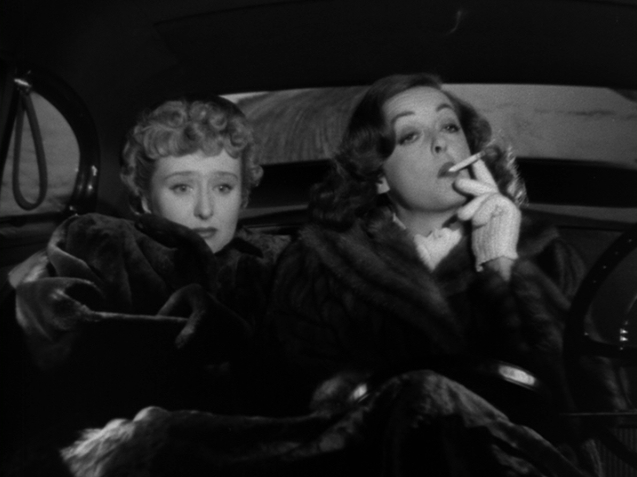
After a brief prologue in which we see a young actress receiving a major acting award in front of people who are shooting daggers from their eyes at her face, harshly narrated by theater critic Addison DeWitt (Oscar winner George Sanders), we flash back. (Second flashback film in a row!) A year earlier, Karen Richards (Oscar nominee Celeste Holm) is going backstage after a performance to see her old friend, aging but respected Broadway star Margo Channing (Oscar nominee Bette Davis), when she happens upon a young fan, Eve Harrington (Oscar nominee Anne Baxter), who claims to have seen every performance of Channing's current outing, a melodrama called "Aged in Wood," but doesn't have the guts to introduce herself. Karen takes an interest in her and brings her backstage to meet her idol, and in the process also meets Karen's playwright husband Lloyd (Hugh Marlowe), Margo's fling Bill Sampson (Gary Merrill) and Margo's quippy maid Birdie (Oscar nominee Thelma Ritter). [ That's right folks, FIVE acting nominees, including four women (the second feat has never since been achieved by any film). ] Having piqued everyone's interest, even the jaded Margo, Eve tells her life story, particularly how it's been enhanced by Ms. Channing's performances. Margo, vain as she is, falls for the girl and gives her a job as her personal assistant.


Margo Channing is a fascinating character, first because of that remarkable switch. At first, Margo is hesitant, even cruel about meeting a fan, but when she hears Eve's tale of adoration, her compassion and tenderness flip on like a light. Birdie is rightfully put off by this new girl in Margo's employ and lays claim to the first sneaking suspicions about Eve. As an audience, we can tell there's something creepy about Anne Baxter's breathy delivery and Terminator-like focus, but nearly every character on screen takes it for sincerity and simplicity... at least at first. But Margo's initial trust of Eve slowly erodes and reveals layer upon drunken layer of paranoia and delusion.


What Eve plays off as simple dreams of a small-town girl Margo slowly starts to take as conniving betrayal. Divas in full force! But her friends don't share or endorse her apprehensions, and soon, it really does become a famously "bumpy night." Alfred Newman's score gives away a little of the surprise, but we're still clutching our pearls all the same.


Is Margo Channing right? Was she right from the beginning to distrust a fan, to even consider fans sub-human?

LLOYD: Have you no human consideration?
MARGO: Show me a human and I might have.

The film deceptively paints her as the villain at first, leaving Eve in the shadows and allowing Margo to wrestle her way to the top of the first half of the story. She appears her alongside her own caricature outside the theater: the audience believes her to be a cartoon, living in a delusional fantasy where every other actress is struggling to take her down. But Eve plays it cool, appearing aloof at even the slightest hint of aggression towards her. Soon, she manages to turn everyone against Margo: her friends, her confidantes, her lover, even the playwright who wrote the role Margo is so terrified of losing to Eve.


"Sink in your mink." -- Ryan Grimes

In order to teach Margo a lesson, Karen devises a plan to have her miss a performance, stalling her car and necessitating Eve's understudy performance that earns raves from critics who all happen to catch her one-night-only engagement. Little does Karen know that Eve planted the idea in her brain in the first place and will use it to her advantage later. Stuck in the car and awaiting help, one of the most telling conversations is also one of the most heartbreaking:

MARGO: So many people know me. I wish I did. I wish someone would tell me about me.
KAREN: You're Margo, just Margo.
MARGO: And what is that, besides something spelled out in light bulbs, I mean - besides something called a temperament, which consists mostly of swooping about on a broomstick and screaming at the top of my voice? Infants behave the way I do, you know. They carry on and misbehave - they'd get drunk if they knew how - when they can't have what they want, when they feel unwanted or insecure or unloved.

This is perhaps the most vulnerable and honest we'll see Margo, however short-lived. She reconciles her fame and her mortality, and seems on the verge of atonement. But she (and the rest of her duped friends) are about to "go to their battle stations."


Much of the film's success lies in Mankiewicz's unparalleled screenplay, endlessly witty and only rivalled on this list by Network, in my opinion, for originality and a generous dose of great characters. The whole affair is awash in backstage bitchery and depressing theater metaphors, which alone would make it must-see entertainment for actors and theater folk. Luckily, it's also blessed by flawless performances from a huge principal cast.


"Nice speech, Eve. But I wouldn't worry about your heart. You can always put that award where your heart ought to be."

George Sanders won an Oscar for his performance as the jaded critic Addison DeWitt, but you're not sure why until his phenomenal last scene. Though wooden for most of the film, Baxter's portrayal of Eve as a conniving skank is spot-on, and her come-uppance is cheer-worthy. Celeste Holm, Thelma Ritter, Gary Merrill and Hugh Marlowe all have chances to shine as well. How many films can you say that about -- SO many juicy roles? Not a lot, says I.


Has Eve become Margo by the end? Is that her greatest curse, or is it that the cycle could start all over again and come back to bite her in the ass? The film's famous ending had me reaching for the rewind button so I could watch it all over again -- or at the very least, finding it used on Amazon so I could watch it whenever, wherever. A total classic, and one I enjoyed even more in the company of friends invested in and intrigued by the bitch factor. A fantastic film, top to bottom.

How can you top that? Gary Cooper's gonna try: it's High Noon, folks.

June 8, 2011

#29: Double Indemnity


Double Indemnity is a 1944 thriller-noir by Billy Wilder, whose cultural impact on cinema cannot be understand thanks to such classics as The Apartment, Some Like It Hot and Sunset Boulevard (all on the list). There is a great economy in his work, and I'll be interested to compare this to the latter two films, which are yet to come on this blog. Honestly though, if you had told me that Hitchcock had directed this, I might have believed you, save the fact that Hitchcock doesn't make a trademark cameo. My last experience with noir was only a few movies ago (The Maltese Falcon) and I was much less taken with that one than I was here, so: a pleasant surprise!

Company: alone, although I had folks express interest, and since it's on instant Netflix I will definitely see it again!

Cuisine: a burger, a few chips and a diet Coke, left over from our Memorial Day barbecue


We open on Walter Neff (a very charming Fred MacMurray), an insurance salesman who looks like shit at the moment. He's taping a confession of a murder he's committed -- thanks for giving away the ending! -- and the entire film acts as a flashback to explain how he got to this sorry state. Somewhere out there there's a list of movies that do this exact thing (Saving Private Ryan and Forrest Gump come to mind). Anyway, his confession acts as an omniscient narration over top of the events surrounding this murder. At first we're agog: how could this seemingly mild-mannered insurance salesman get mixed up in this? I'll tell you how.


Meet "how."

Enter Phyllis Dietrichson (Oscar nominee and femme fatale to end all Barbara Stanwyck), a trophy wife and would-be merry murderess, whom Walter meets on a routine house call during which he had hoped to renew Mr. Dietrichson's auto insurance policy. She wants her husband dead, and the phenomenal first scene between Walter and Phyllis makes it all too clear how badly they want each other from the first moment. Their flirtation is mouth-watering and electric, but Neff senses that she's bad news and wants no part in her scheme. But he's already doomed: he can think of nothing but her. Supposedly Wilder put Stanwyck in a purposefully awful wig to show that something's not quite right about her, and how right he is.


The plan is simple (ha!): Walter sells Phyllis' husband an accident policy that insures the owner with a 'double indemnity' clause (hey, that's the title!), which basically covers the owner twice over in the event of an unlikely accident, for example, death in a train accident. Then the scheme goes that the pair will stage the husband's death, making it look like an accident, claim the $100,000 and be together forever. What could possibly go wrong? It's a film that constructs, at least in the mind of its anti-heroes, a perfect crime, and both MacMurray and Stanwyck make such believable bad good-doers that the audience can't imagine what could stop them.


Except, of course, for the one factor that they never thought about: the racking guilt of their crime. It's a great thrill to see their plan put into action, knowing exactly how it must happen and biting our nails when something happens that they don't expect. What did they forget? Will that man at the back of the train come back to haunt them? The pace of the thrills never lets up, especially not after the crime has been committed. One of the most chilling elements is the above shot of Phyllis, staring straight ahead as her husband is strangled next to her. So unfeeling, so calculated, so sure that it will work... right?


Unluckily for Neff, he's got a boss who hates when he can't see through a phony claim, and Barton Keyes (a fantastic Edward G. Robinson) is on the case. He's never been stumped by a claim before, and sets his mind to figuring it all out. The great thrills that come from watching those cogs turn as the murderers are right under his nose! How short my nails got as I bit them while Phyllis hid behind the door with Keyes not ten feet away! This is thrilling cinema, friends.


Because it's thrilling and because it's the not knowing that keeps you on the edge of your seat, I wouldn't dream of spoiling the ending, but suffice it to say that if I thought I knew where the film was going I was wrong. I think one of the master strokes of the film is how Wilder balances these three characters: whose side are you on? Do you want the plan to work, without any hitches? Are we hoping they'll get caught? Do we root for Keyes to discover their deeds? We're never fully on any one character's side; even though Neff narrates, it really feels like the same story told from three fully-developed angles, and the complexity of the heightened emotion of noir is never lost on Wilder.


Those Venetian blinds!

It's this complex story line, so smart and so involving, that keeps the audience guessing until the last moments. I read that this film was one of the first, if not the first, to really investigate and even justify the intricacies of a homicide, and boy does it ever. Perhaps it's these complexities that drew me in the way The Maltese Falcon just didn't. There, Humphrey Bogart's character was essentially alone in solving a crime of which we the audience were not a part. Here, we're presented with all the details of a crime, and then watch as the trio of detective, the detective-turned-murderer and the murderess play that lethal game of cat and mouse (and mouse), witnessing simultaneous sides of the crime. Genius.

Love it love it! Another wonderful surprise.

Nothing surprising about the next film, however, at least none that I don't remember fondly from the last time I saw it in college: buckle up, it's gonna be a bumpy ride with Joseph L. Mankiewicz's classic All About Eve.